
🚀 宇宙の記憶・カレンダー検索
🚀 象徴的な写真:
APOD第1回
🚀 創造の柱
🚀 スピリット火星着陸
🚀 ハッブル超深宇宙
🚀 地球へようこそ|ブルー・マーブル
🚀 エンケラドス
🚀 ベテルギウス
🚀 火星着陸
🚀 青い夕焼け
🚀 冥王星のハート
🚀 皆既日食
🚀 アースライズ再構築
🚀 ブラックホール
🚀 ウェッブ初画像
🚀 アポロ11着陸
APOD30周年(2025年6月16日)
ウィルソン山にあるフッカー望遠鏡
The Hooker Telescope on Mt. Wilson
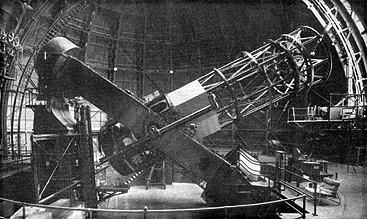
1995年7月1日 ウィルソン山のフッカー望遠鏡 写真提供:ウィルソン山天文台 説明:1920年代、ウィルソン山のフッカー望遠鏡で撮影された写真は、宇宙に対する私たちの理解を根本的に変えました。天文学者エドウィン・ハッブルは、この望遠鏡で撮影した写真を用いて、同時代の人々が「渦巻星雲」と呼んでいた天体が、実際には巨大な星のシステム、つまり渦巻銀河であり、私たちの天の川銀河に似ているものの、信じられないほど遠いものであることを示しました。ハッブルの研究以前は、渦巻星雲は単なるガスの雲であり、宇宙の他のすべてのものと同様に、私たちの銀河の中に収まっていると考えられていました。フッカー望遠鏡の鏡は直径100インチで、ハッブルにちなんで名付けられた軌道上のハッブル宇宙望遠鏡の鏡とほぼ同じ大きさです。ウィルソン山天文台では、この歴史的な望遠鏡の「バーチャルウォーキングツアー」を提供しています。詳細については、マウント・ウィルソン天文台の歴史的画像アーカイブをご覧ください。当天文台では、「今日の天体写真」のアーカイブを保管しています。「今日の天体写真」は、ロバート・ネミロフとジェリー・ボネルによって提供されています。このページに掲載されているオリジナル資料の著作権は、ロバート・J・ネミロフとジェリー・T・ボネルに帰属します。
原文(English)
July 1, 1995 The Hooker Telescope on Mt. Wilson Picture Credit: Mount Wilson Observatory Explanation: In the 1920s, pictures from the Hooker Telescope on Mt. Wilson fundamentally changed our understanding of the cosmos. Astronomer Edwin Hubble, using photographs he took with this telescope, demonstrated that the objects his contemporaries called "spiral nebulae" were actually huge systems of stars - spiral galaxies, similar to our own Milky Way galaxy but incredibly distant. Prior to Hubble's work it was argued that the spiral nebulae were mere clouds of gas and that they, along with everything else in the universe, were contained in our own galaxy. The Hooker Telescope mirror is 100 inches in diameter which is nearly the size of the mirror of the orbiting Hubble Space Telescope named in Hubble's honor. The Mount Wilson Observatory offers a "virtual walking tour" of this historic telescope. For more information see Mount Wilson Observatory Historical Image Archives We keep an archive of Astronomy Pictures of the Day. Astronomy Picture of the Day is brought to you by Robert Nemiroff and Jerry Bonnell . Original material on this page is copyrighted to Robert J. Nemiroff and Jerry T. Bonnell.
\ この感動を宇宙仲間にシェア /
宇宙をXでシェア
© NASA / APOD