
🚀 宇宙の記憶・カレンダー検索
🚀 象徴的な写真:
APOD第1回
🚀 創造の柱
🚀 スピリット火星着陸
🚀 ハッブル超深宇宙
🚀 地球へようこそ|ブルー・マーブル
🚀 エンケラドス
🚀 ベテルギウス
🚀 火星着陸
🚀 青い夕焼け
🚀 冥王星のハート
🚀 皆既日食
🚀 アースライズ再構築
🚀 ブラックホール
🚀 ウェッブ初画像
🚀 アポロ11着陸
APOD30周年(2025年6月16日)
二つの世界、一つの太陽
Two Worlds, One Sun
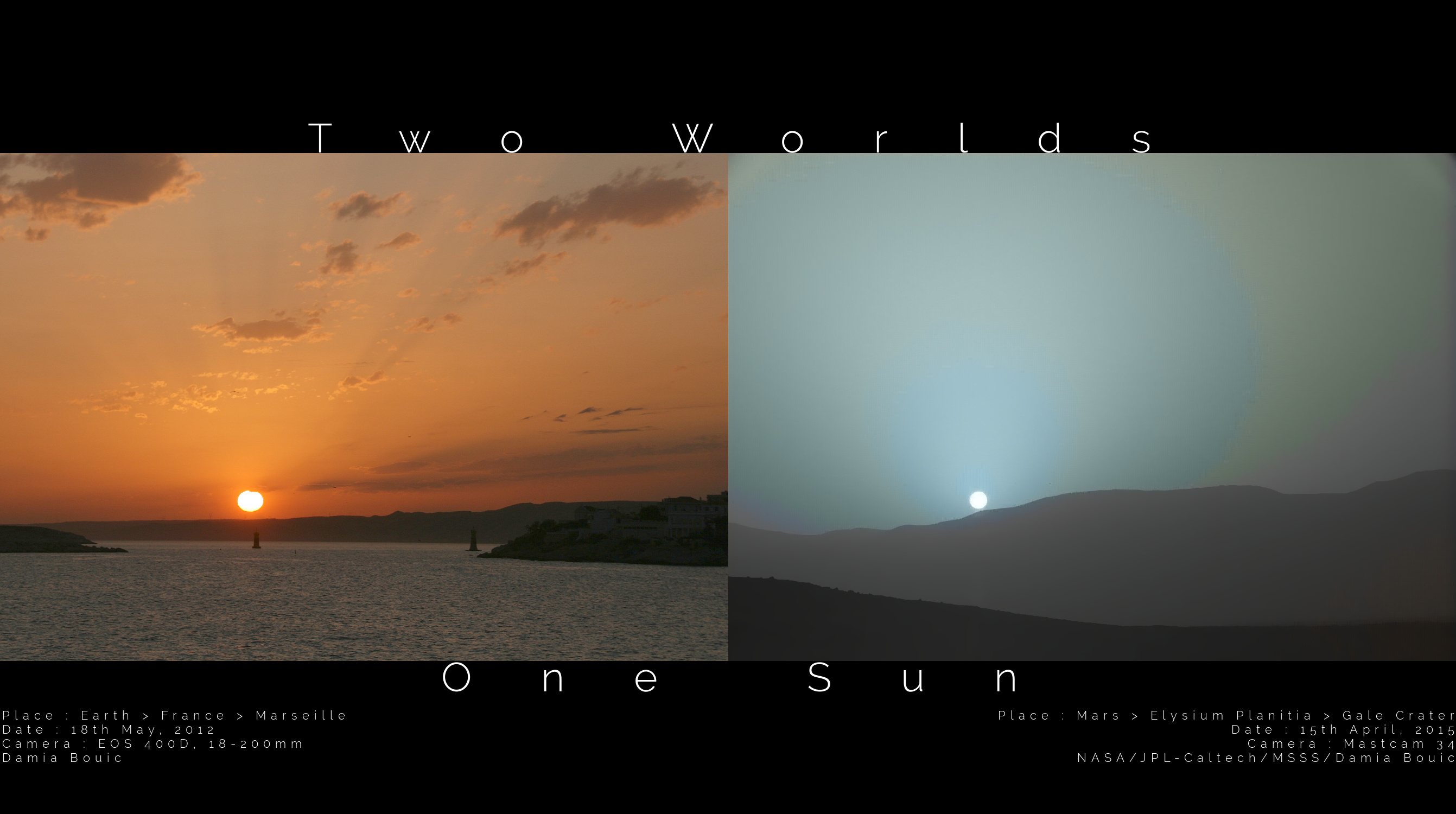
火星から見た夕日は、地球から見た夕日とどれほど違うのでしょうか?比較のために、太陽の画像を2枚用意しました。1枚は地球から、もう1枚は火星から撮影したものです。これらの画像は、同じ角度幅になるように拡大縮小され、ここに並べて掲載されています。よく見ると、火星から見た太陽は地球から見た太陽よりもわずかに小さく見えます。火星は地球よりも太陽から50%遠いので、これは当然のことです。おそらくもっと印象的なのは、火星の夕日は、地球から見た夕日の典型的なオレンジ色よりも、太陽の近くの色が明らかに青みがかっていることです。火星の夕日が青みがかる理由は完全には解明されていませんが、火星の塵の前方散乱特性に関係していると考えられています。地球の夕日は2012年3月にフランスのマルセイユで撮影され、火星の夕日は先月、NASAの探査車キュリオシティが火星のゲール・クレーターで撮影したものです。
原文(English)
How different does sunset appear from Mars than from Earth? For comparison, two images of our common star were taken at sunset, one from Earth and one from Mars. These images were scaled to have same angular width and featured here side-by-side. A quick inspection will reveal that the Sun appears slightly smaller from Mars than from Earth. This makes sense since Mars is 50% further from the Sun than Earth. More striking, perhaps, is that the Martian sunset is noticeably bluer near the Sun than the typically orange colors near the setting Sun from Earth. The reason for the blue hues from Mars is not fully understood, but thought to be related to forward scattering properties of Martian dust. The terrestrial sunset was taken in 2012 March from Marseille, France, while the Martian sunset was captured last month by NASA's robotic Curiosity rover from Gale crater on Mars.
\ この感動を宇宙仲間にシェア /
宇宙をXでシェア
© Damia Bouic;
Right Image Credit: NASA,
JPL-Caltech,
MSSS;
Digital processing:
Damia Bouic / APOD