
🚀 宇宙の記憶・カレンダー検索
🚀 象徴的な写真:
APOD第1回
🚀 創造の柱
🚀 スピリット火星着陸
🚀 ハッブル超深宇宙
🚀 地球へようこそ|ブルー・マーブル
🚀 エンケラドス
🚀 ベテルギウス
🚀 火星着陸
🚀 青い夕焼け
🚀 冥王星のハート
🚀 皆既日食
🚀 アースライズ再構築
🚀 ブラックホール
🚀 ウェッブ初画像
🚀 アポロ11着陸
APOD30周年(2025年6月16日)
ブラックホールの地平線スケール画像が初公開
First Horizon-Scale Image of a Black Hole
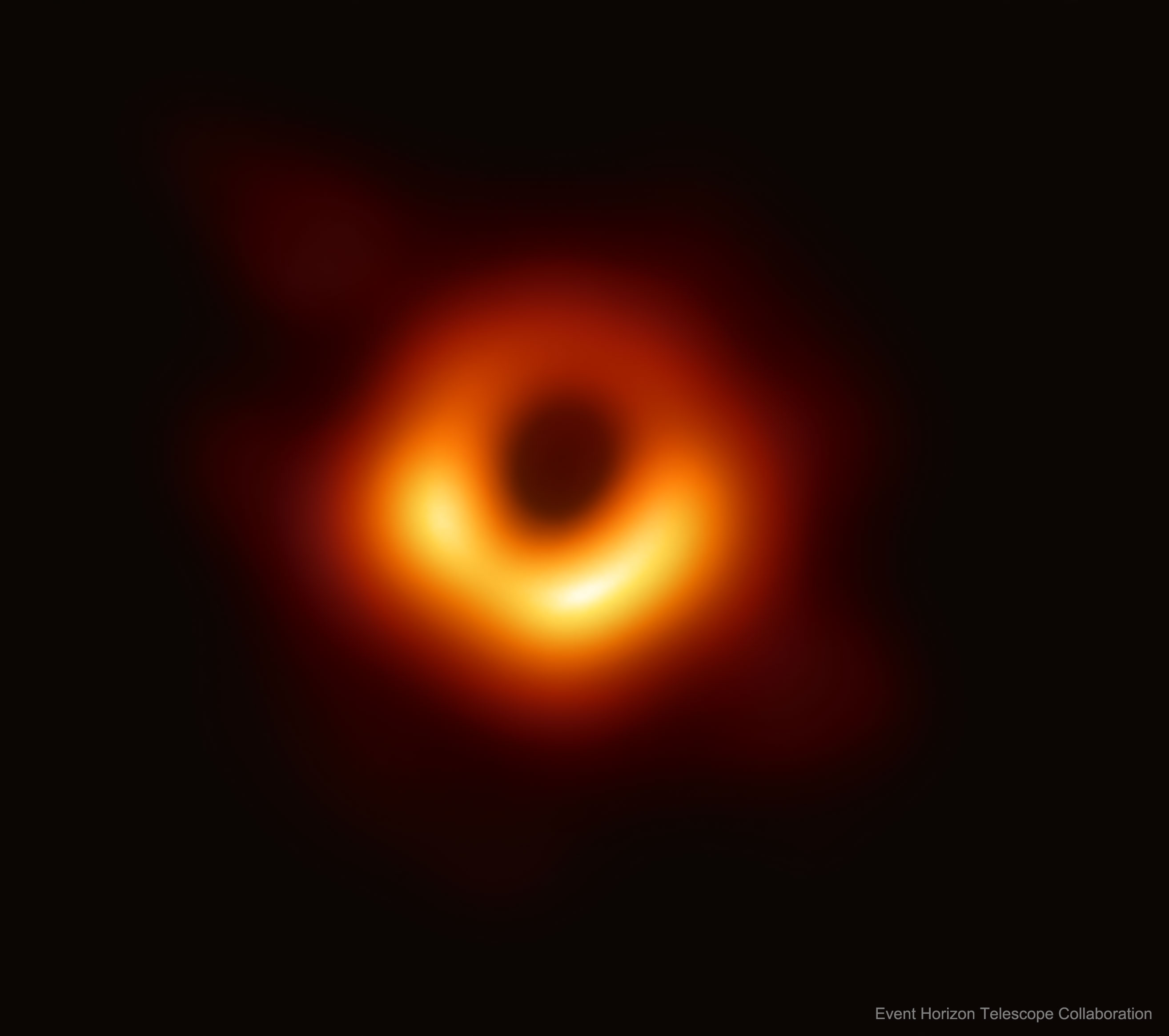
ブラックホールはどのような姿をしているのでしょうか?それを知るために、地球上の電波望遠鏡が連携して、空で知られている最大の事象の地平線を持つブラックホールの観測を行いました。ブラックホール単体ではただ黒いだけですが、これらの巨大な吸引体は輝くガスに囲まれていることが知られています。昨日公開された最初の画像は、銀河M87の中心にあるブラックホールの周囲の領域を、その事象の地平線として予想されるスケールよりも小さいスケールで解像しました。画像に写っている暗い中心領域は事象の地平線ではなく、ブラックホールの影、つまり中心のブラックホールの重力によって暗くなった放射ガスの中心領域です。影の大きさや形は、事象の地平線付近の明るいガス、強い重力レンズ効果による偏向、そしてブラックホールの自転によって決まります。このブラックホールの影を解像することで、イベントホライズンテレスコープ(EHT)は、アインシュタインの重力が極限領域でも機能するという証拠を強化し、M87には太陽質量の約60億倍の中央回転ブラックホールが存在するという明確な証拠を示しました。 EHTの計画はまだ終わっていません。今後の観測は、さらに高解像度化、変動性のより正確な追跡、そして天の川銀河の中心にあるブラックホールのすぐ近傍の探査に重点が置かれる予定です。
原文(English)
What does a black hole look like? To find out, radio telescopes from around the Earth coordinated observations of black holes with the largest known event horizons on the sky. Alone, black holes are just black, but these monster attractors are known to be surrounded by glowing gas. The first image was released yesterday and resolved the area around the black hole at the center of galaxy M87 on a scale below that expected for its event horizon. Pictured, the dark central region is not the event horizon, but rather the black hole's shadow -- the central region of emitting gas darkened by the central black hole's gravity. The size and shape of the shadow is determined by bright gas near the event horizon, by strong gravitational lensing deflections, and by the black hole's spin. In resolving this black hole's shadow, the Event Horizon Telescope (EHT) bolstered evidence that Einstein's gravity works even in extreme regions, and gave clear evidence that M87 has a central spinning black hole of about 6 billion solar masses. The EHT is not done -- future observations will be geared toward even higher resolution, better tracking of variability, and exploring the immediate vicinity of the black hole in the center of our Milky Way Galaxy.
\ この感動を宇宙仲間にシェア /
宇宙をXでシェア
© NASA / APOD