
🚀 宇宙の記憶・カレンダー検索
🚀 象徴的な写真:
APOD第1回
🚀 創造の柱
🚀 スピリット火星着陸
🚀 ハッブル超深宇宙
🚀 地球へようこそ|ブルー・マーブル
🚀 エンケラドス
🚀 ベテルギウス
🚀 火星着陸
🚀 青い夕焼け
🚀 冥王星のハート
🚀 皆既日食
🚀 アースライズ再構築
🚀 ブラックホール
🚀 ウェッブ初画像
🚀 アポロ11着陸
APOD30周年(2025年6月16日)
アインシュタインクロスのマイクロレンズ効果
Microlensing of the Einstein Cross
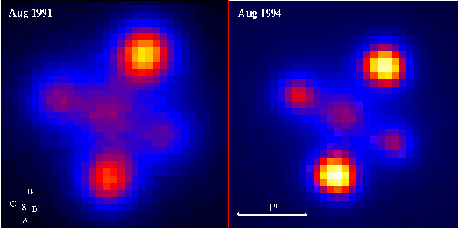
1995年7月11日 アインシュタイン・クロスのマイクロレンズ効果 写真提供:ゲライント・ルイス、マイケル・アーウィン、ウィリアム・ハーシェル望遠鏡 解説:有名な「アインシュタイン・クロス」は、一つの天体が4回見える現象です。ここでは、非常に遠方のクエーサーが巨大な銀河のすぐ後ろに位置していました。銀河の重力が遠方のクエーサーに及ぼす影響は、遠くの街灯にグラスを置いたときのレンズ効果に似ており、複数の像を作り出しました。しかし、手前の銀河にある星々も、ここで重力レンズとして作用していることが分かりました。これらの星々によって、像の明るさが互いに変化します。この明るさの変化は、約3年の間隔を置いて撮影されたアインシュタイン・クロスの2枚の写真で確認できます。この写真の詳細については、1995年7月9日~14日にオーストラリアのメルボルンで開催されたIAUシンポジウム173「重力レンズの天体物理学的応用」のホームページをご覧ください。私たちは「今日の天体写真」のアーカイブを保持しています。 「今日の天体写真」は、ロバート・ネミロフとジェリー・ボネルがお届けします。このページに掲載されているオリジナル素材の著作権は、ロバート・J・ネミロフとジェリー・T・ボネルに帰属します。
原文(English)
July 11, 1995 Microlensing of the Einstein Cross Picture Credit: Geraint Lewis and Michael Irwin, William Hershel Telescope Explanation: The famous "Einstein Cross" is a case where a single object is seen four times. Here a very distant QSO happened to be placed right behind a massive galaxy. The gravitational effect of the galaxy on the distant QSO was similar to the lens effect of a drinking glass on a distant street light - it created multiple images. But stars in the foreground galaxy have been found to act as gravitational lenses here too! These stars make the images change brightness relative to each other. These brightness changes are visible on these two photographs of the Einstein Cross, taken about 3 years apart. For more information about this picture see the home page of the IAU Symposium 173 Astrophysical Applications of Gravitational Lensing in Melbourne, Australia 9-14 July, 1995. We keep an archive of Astronomy Pictures of the Day. Astronomy Picture of the Day is brought to you by Robert Nemiroff and Jerry Bonnell . Original material on this page is copyrighted to Robert J. Nemiroff and Jerry T. Bonnell.
\ この感動を宇宙仲間にシェア /
宇宙をXでシェア
© NASA / APOD