
🚀 宇宙の記憶・カレンダー検索
🚀 象徴的な写真:
APOD第1回
🚀 創造の柱
🚀 スピリット火星着陸
🚀 ハッブル超深宇宙
🚀 地球へようこそ|ブルー・マーブル
🚀 エンケラドス
🚀 ベテルギウス
🚀 火星着陸
🚀 青い夕焼け
🚀 冥王星のハート
🚀 皆既日食
🚀 アースライズ再構築
🚀 ブラックホール
🚀 ウェッブ初画像
🚀 アポロ11着陸
APOD30周年(2025年6月16日)
天の川銀河の中心
The Milky Way's Center
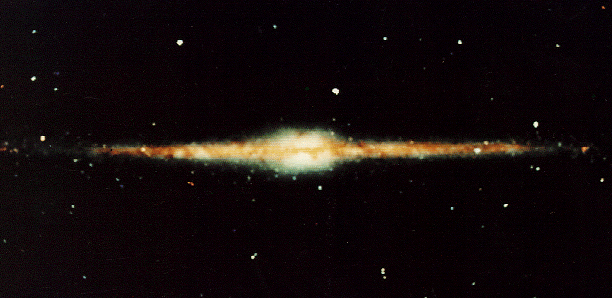
1995年9月8日 天の川銀河の中心部 提供:NASA、COBEプロジェクト 解説:NASAのCOBE衛星は1990年に赤外線波長で宇宙をスキャンし、私たちの銀河系である天の川銀河の中心部のこの素晴らしい画像を作成しました。天の川銀河は、中心部にバルジがあり、星の円盤が広がっている典型的な渦巻銀河です。しかし、円盤内のガスと塵が可視光の波長を遮り、中心部をはっきりと観測することを妨げています。赤外線波長は遮蔽物質の影響を受けにくいため、COBEに搭載された拡散赤外線背景実験装置(DIRBE)は、銀河中心を取り囲む星からの赤外線を検出し、この画像を作成することができました。もちろん、遠近法で描かれているのは、中心から約3万光年離れた円盤内の恒星である太陽の近傍からの眺めです。 DIRBE実験では、液体ヘリウムの入った容器で冷却された装置を用いて赤外線を検出した。赤外線は赤色光よりも波長が長く、人間の目には見えない。
原文(English)
September 8, 1995 The Milky Way's Center Credit: NASA, COsmic Background Explorer (COBE) Project Explanation: NASA's COBE satellite scanned the heavens at infrared wavelengths in 1990 and produced this premier view of the central region of our own Milky Way Galaxy. The Milky Way is a typical spiral galaxy with a central bulge and extended disk of stars. However, gas and dust within the disk obscure visible wavelengths of light effectively preventing clear observations of the center. Since infrared wavelengths, are less affected by the obscuring material, the Diffuse InfraRed Background Experiment (DIRBE) on board COBE was able to detected infrared light from stars surrounding the galactic center and produce this image. Of course, the edge on perspective represents the view from the vicinity of our Sun, a star located in the disk about 30,000 light years out from the center. The DIRBE experiment used equipment cooled by a tub of liquid helium to detect the infrared light which, composed of wavelengths longer than red light, is invisible to the human eye.
\ この感動を宇宙仲間にシェア /
宇宙をXでシェア
© NASA / APOD