
🚀 宇宙の記憶・カレンダー検索
🚀 象徴的な写真:
APOD第1回
🚀 創造の柱
🚀 スピリット火星着陸
🚀 ハッブル超深宇宙
🚀 地球へようこそ|ブルー・マーブル
🚀 エンケラドス
🚀 ベテルギウス
🚀 火星着陸
🚀 青い夕焼け
🚀 冥王星のハート
🚀 皆既日食
🚀 アースライズ再構築
🚀 ブラックホール
🚀 ウェッブ初画像
🚀 アポロ11着陸
APOD30周年(2025年6月16日)
バーデの窓を通して見る
Lensing through Baade's Window
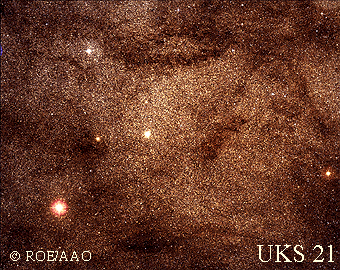
私たちの銀河系はどのような形と構成をしているのでしょうか? 塵がそれほど多くなければ、この質問に答えるのはもっと簡単でしょう。しかし、1940年代に天文学者のウォルター・バーデは、銀河系の中心付近に、比較的不透明な塵が少ない「窓」を発見しました。現在「バーデの窓」と呼ばれるこの空域には数百万個の星があり、遠方の銀河系の多くの研究に利用されています。ボフダン・パチンスキーが考案した巧妙な利用法の一つは、銀河バルジにある数百万個の星(その多くはバーデの窓を通して見える)を、重力レンズ効果による突然の増光を監視することです。OGLEとMACHOの共同研究による現在の観測では、数十件の重力増幅現象が確認されています。この予想外に多い数は、銀河系の中心核を横切るように太陽にほぼ向いている星の「棒」が存在するという以前の主張を裏付けています。
原文(English)
What is the shape and composition of our Milky Way Galaxy? This question would be easier to answer if there wasn't so much obscuring dust! In the 1940s, however, astronomer Walter Baade identified a "window" near the center of our Galaxy where there is comparatively little opaque dust. Now called "Baade's Window", this sky region contains millions of stars and is used for many studies of the distant Milky Way. One clever use, devised by Bohdan Paczynski, is to monitor millions of stars in our Galactic Bulge - many through Baade's window - for sudden brightening due to gravitational lensing. Current observations by the OGLE and MACHO collaborations have now identified dozens of gravitational amplification events. This unexpectedly large number supports previous claims that our Galaxy has a "bar" of stars across the central nucleus, pointed nearly at the Sun.
\ この感動を宇宙仲間にシェア /
宇宙をXでシェア
© Anglo-Australian Telescope
Board / APOD