
🚀 宇宙の記憶・カレンダー検索
🚀 象徴的な写真:
APOD第1回
🚀 創造の柱
🚀 スピリット火星着陸
🚀 ハッブル超深宇宙
🚀 地球へようこそ|ブルー・マーブル
🚀 エンケラドス
🚀 ベテルギウス
🚀 火星着陸
🚀 青い夕焼け
🚀 冥王星のハート
🚀 皆既日食
🚀 アースライズ再構築
🚀 ブラックホール
🚀 ウェッブ初画像
🚀 アポロ11着陸
APOD30周年(2025年6月16日)
百武彗星の回転する噴流
The Rotating Jets of Comet Hyakutake
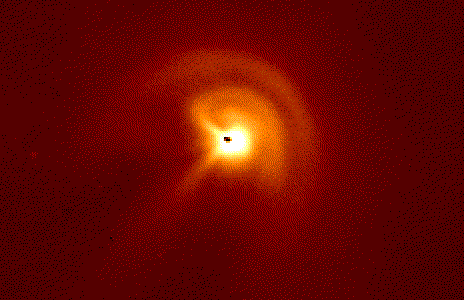
百武彗星は5月1日に太陽に最も接近し、水星の軌道の内側を通過します。このとき、彗星の塵とイオンの尾は物理的に最大の長さになります。彗星が太陽に近づくと、ガスと塵が表面から吹き飛ばされ、時にはジェットとして噴出します。これらの物質の多くは尾に集まりますが、彗星の直径3キロメートルの核の近くには興味深い特徴が見られます。彗星の核は自転しているため、ジェットは彗星の中心の周りに風車のような弧を描いているのが見えます。4月8日に撮影された上の写真は、2つの膨張する彗星物質の弧と2つの噴出源を示しています。最も外側の弧は核から12,000キロメートルの投影距離にあります。内側の弧は核から約8,000キロメートルです。これらは核から時速870キロメートルで膨張しています。内側の弧は、百武彗星の数多くの噴出物の中で最も明るい部分で終わる。参考資料:1996年4月の宇宙規模論争
原文(English)
Comet Hyakutake will reach its closest point to the Sun on May 1, passing well inside the orbit of Mercury. At this time, the comet's dust and ion tail will be at their greatest physical length. As the comet nears the Sun, gas and dust are driven off the surface, sometimes being shot off in jets. Although much of this material ends up in the tail, some interesting features can be seen close to the comet's three kilometer nucleus. Because the comet's nucleus rotates, the jets can be seen to form arcs around the comet's center resembling a pinwheel. The above photograph, taken April 8, shows two expanding arcs of cometary material and two source jets. The outermost arc is at a projected distance of 12,000 kilometers from the nucleus. The inner is about 8,000 kilometers from the nucleus. They are expanding from the nucleus at 870 km per hour. The inner arc ends at the brightest of the Comet Hyakutake's many jets. Information: The Scale of the Universe Debate in April 1996
\ この感動を宇宙仲間にシェア /
宇宙をXでシェア
© NASA / APOD