
🚀 宇宙の記憶・カレンダー検索
🚀 象徴的な写真:
APOD第1回
🚀 創造の柱
🚀 スピリット火星着陸
🚀 ハッブル超深宇宙
🚀 地球へようこそ|ブルー・マーブル
🚀 エンケラドス
🚀 ベテルギウス
🚀 火星着陸
🚀 青い夕焼け
🚀 冥王星のハート
🚀 皆既日食
🚀 アースライズ再構築
🚀 ブラックホール
🚀 ウェッブ初画像
🚀 アポロ11着陸
APOD30周年(2025年6月16日)
翻訳エラー: Exception: 1 日にサービス translate を実行した回数が多すぎます。
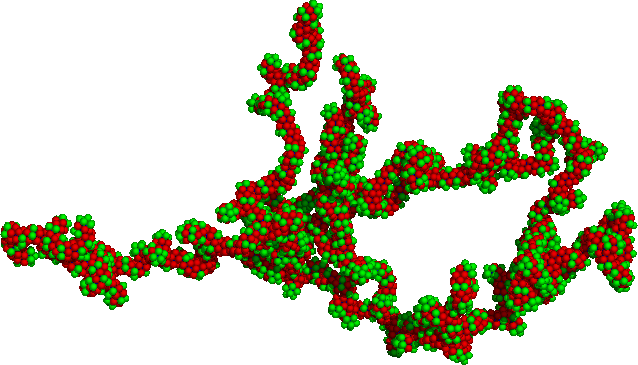
Fractal Interstellar Dust Up-Close
翻訳エラー: Exception: 1 日にサービス translate を実行した回数が多すぎます。
原文(English)
Our universe is a very dusty place. Dust usually shows its presence by blocking out light emitted from stars or nebulae behind it, sometimes creating the illusion of a horse's head or a sombrero hat. But nobody really knows what a typical interstellar dust grain looks like. By studying how dust absorbs, emits, and reflects light, astronomers do know that interstellar dust is much different than the cell and lint based dust found around a typical house. Interstellar dust grains are composed mostly of carbon, silicon, and oxygen and are usually less than about 1/1000 of a millimeter across. Recent work indicates that most dust grains are not spherical. The above picture shows the result of a fractal adhesion model for dust grains involving random conglomerates of spherical compounds of different properties, here artificially highlighted by different colors.
\ この感動を宇宙仲間にシェア /
宇宙をXでシェア
©
E. L. Wright
(UCLA)
/ APOD