
🚀 宇宙の記憶・カレンダー検索
🚀 象徴的な写真:
APOD第1回
🚀 創造の柱
🚀 スピリット火星着陸
🚀 ハッブル超深宇宙
🚀 地球へようこそ|ブルー・マーブル
🚀 エンケラドス
🚀 ベテルギウス
🚀 火星着陸
🚀 青い夕焼け
🚀 冥王星のハート
🚀 皆既日食
🚀 アースライズ再構築
🚀 ブラックホール
🚀 ウェッブ初画像
🚀 アポロ11着陸
APOD30周年(2025年6月16日)
翻訳エラー: Exception: 1 日にサービス translate を実行した回数が多すぎます。
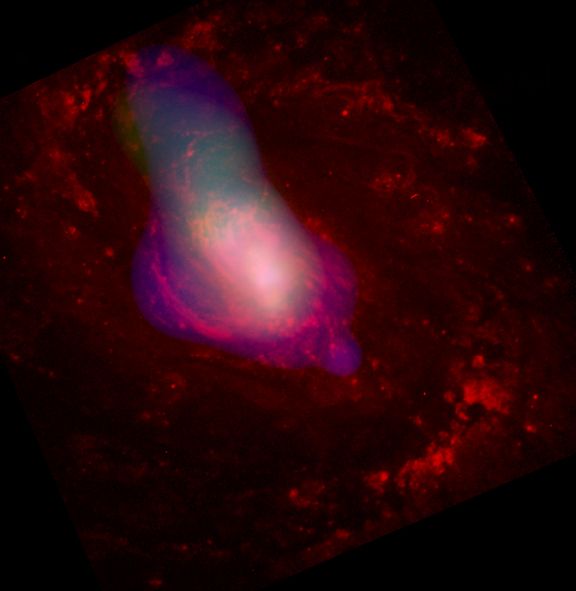
NGC 1068 and the X-Ray Flashlight
翻訳エラー: Exception: 1 日にサービス translate を実行した回数が多すぎます。
原文(English)
At night, tilting a flashlight up under your chin hides the glowing bulb from the direct view of your friends. Light from the bulb still reflects from your face though, and can give you a startling appearance. Spiral Galaxy NGC 1068 may be playing a similar trick on a cosmic scale, hiding a central powerful source of x-rays -- likely a supermassive black hole -- from direct view. X-rays are still scattered into our line-of-sight though, by a dense torus of material surrounding the black hole. The scenario is supported by x-ray data from the Chandra Observatory combined with a Hubble Space Telescope optical image in this false-color composite picture. Optical data in red shows spiral structure across NGC 1068's inner 7 thousand light-years with the x-ray data overlaid in blue and green. A hot wind of gas streaming from the galaxy's core is seen as the broad swath of x-ray emission while material lit up by the hidden black hole source is within the central cloud of more intense x-rays. Also well known as M77, NGC 1068 lies a mere 50 million light-years away toward the constellation Cetus.
\ この感動を宇宙仲間にシェア /
宇宙をXでシェア
© NASA / APOD