
🚀 宇宙の記憶・カレンダー検索
🚀 象徴的な写真:
APOD第1回
🚀 創造の柱
🚀 スピリット火星着陸
🚀 ハッブル超深宇宙
🚀 地球へようこそ|ブルー・マーブル
🚀 エンケラドス
🚀 ベテルギウス
🚀 火星着陸
🚀 青い夕焼け
🚀 冥王星のハート
🚀 皆既日食
🚀 アースライズ再構築
🚀 ブラックホール
🚀 ウェッブ初画像
🚀 アポロ11着陸
APOD30周年(2025年6月16日)
翻訳エラー: Exception: 1 日にサービス translate を実行した回数が多すぎます。
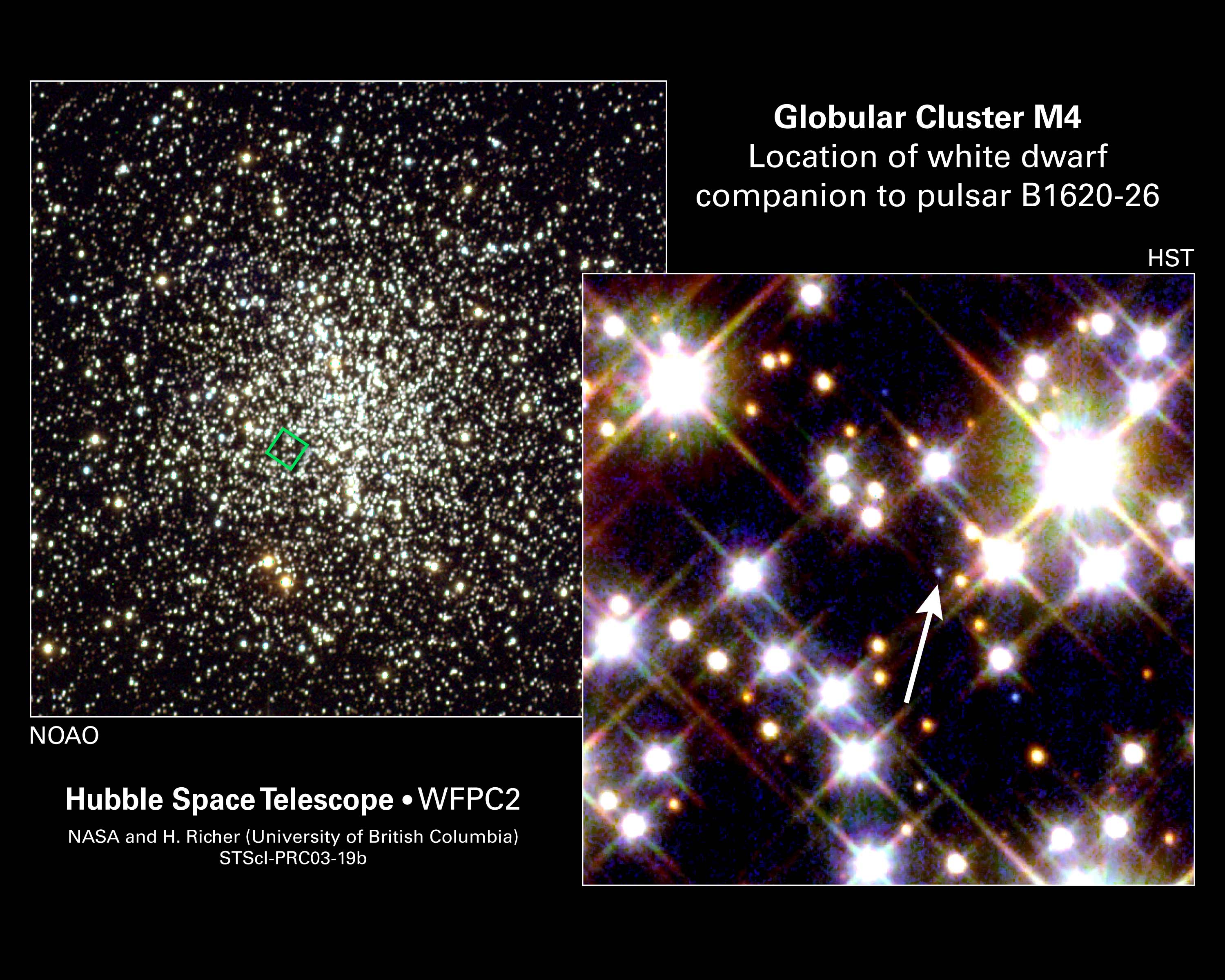
The Planet, the White Dwarf, and the Neutron Star
翻訳エラー: Exception: 1 日にサービス translate を実行した回数が多すぎます。
原文(English)
A planet, a white dwarf, and a neutron star orbit each other in the giant globular star cluster M4, some 5,600 light-years away. The most visible member of the trio is the white dwarf star, indicated above in an image from the Hubble Space Telescope, while the neutron star is detected at radio frequencies as a pulsar. A third body was known to be present in the pulsar/white dwarf system and a detailed analysis of the Hubble data has indicated it is indeed a planet with about 2.5 times the mass of Jupiter. In such a system, the planet is likely to be about 13 billion years old. Compared to our solar system's tender 4.5 billion years and other identified planets of nearby stars, this truly ancient world is by far the oldest planet known, almost as old as the Universe itself. Its discovery as part of an evolved cosmic trio suggests that planet formation spans the age of the Universe and that this newly discovered planet is likely only one of many formed in the crowded environs of globular star clusters.
\ この感動を宇宙仲間にシェア /
宇宙をXでシェア
© NASA / APOD