
🚀 宇宙の記憶・カレンダー検索
🚀 象徴的な写真:
APOD第1回
🚀 創造の柱
🚀 スピリット火星着陸
🚀 ハッブル超深宇宙
🚀 地球へようこそ|ブルー・マーブル
🚀 エンケラドス
🚀 ベテルギウス
🚀 火星着陸
🚀 青い夕焼け
🚀 冥王星のハート
🚀 皆既日食
🚀 アースライズ再構築
🚀 ブラックホール
🚀 ウェッブ初画像
🚀 アポロ11着陸
APOD30周年(2025年6月16日)
翻訳エラー: Exception: 1 日にサービス translate を実行した回数が多すぎます。
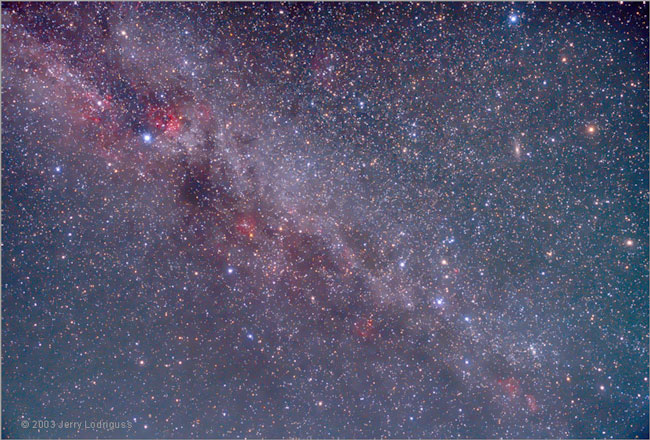
The Northern Milky Way
翻訳エラー: Exception: 1 日にサービス translate を実行した回数が多すぎます。
原文(English)
Many of the stars in our home Milky Way Galaxy appear together as a dim band on the sky that passes nearly over the Earth's north and south poles. Pictured above is the part of our Galaxy that passes closest over the north pole. Placing your cursor over the image will bring up the names of several constellations and bright stars. The diffuse white Galaxy glow is created by billions of stars, while red patches are large emission nebulas, usually marking areas where bright stars have recently formed. In the north, all of the lights visible at night and all lights that created this image were emitted within the past few thousand years from within the Milky Way Galaxy -- except one. On the upper right is a small faint patch designated M31, the Andromeda Galaxy. M31 is a spiral galaxy similar to our Milky Way but so distant it emits the oldest light distinguishable by the unaided eye -- light that takes over two million years to reach us.
\ この感動を宇宙仲間にシェア /
宇宙をXでシェア
© Astropix.com / APOD