
🚀 宇宙の記憶・カレンダー検索
🚀 象徴的な写真:
APOD第1回
🚀 創造の柱
🚀 スピリット火星着陸
🚀 ハッブル超深宇宙
🚀 地球へようこそ|ブルー・マーブル
🚀 エンケラドス
🚀 ベテルギウス
🚀 火星着陸
🚀 青い夕焼け
🚀 冥王星のハート
🚀 皆既日食
🚀 アースライズ再構築
🚀 ブラックホール
🚀 ウェッブ初画像
🚀 アポロ11着陸
APOD30周年(2025年6月16日)
翻訳エラー: Exception: 1 日にサービス translate を実行した回数が多すぎます。
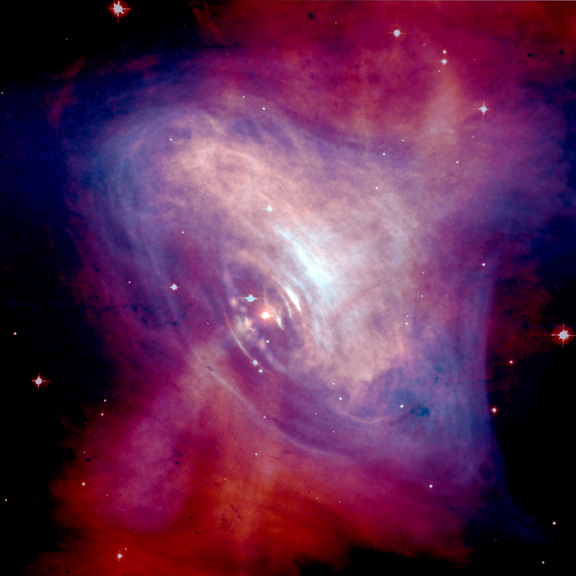
Composite Crab
翻訳エラー: Exception: 1 日にサービス translate を実行した回数が多すぎます。
原文(English)
The Crab Pulsar, a city-sized, magnetized neutron star spinning 30 times a second, lies at the center of this composite image of the inner region of the well-known Crab Nebula. The spectacular picture combines optical data (red) from the Hubble Space Telescope and x-ray images (blue) from the Chandra Observatory, also used in the popular Crab Pulsar movies. Like a cosmic dynamo the pulsar powers the x-ray and optical emission from the nebula, accelerating charged particles and producing the eerie, glowing x-ray jets. Ring-like structures are x-ray emitting regions where the high energy particles slam into the nebular material. The innermost ring is about a light-year across. With more mass than the Sun and the density of an atomic nucleus, the spinning pulsar is the collapsed core of a massive star that exploded, while the nebula is the expanding remnant of the star's outer layers. The supernova explosion was witnessed in the year 1054.
\ この感動を宇宙仲間にシェア /
宇宙をXでシェア
© NASA / APOD