
🚀 宇宙の記憶・カレンダー検索
🚀 象徴的な写真:
APOD第1回
🚀 創造の柱
🚀 スピリット火星着陸
🚀 ハッブル超深宇宙
🚀 地球へようこそ|ブルー・マーブル
🚀 エンケラドス
🚀 ベテルギウス
🚀 火星着陸
🚀 青い夕焼け
🚀 冥王星のハート
🚀 皆既日食
🚀 アースライズ再構築
🚀 ブラックホール
🚀 ウェッブ初画像
🚀 アポロ11着陸
APOD30周年(2025年6月16日)
翻訳エラー: Exception: 1 日にサービス translate を実行した回数が多すぎます。
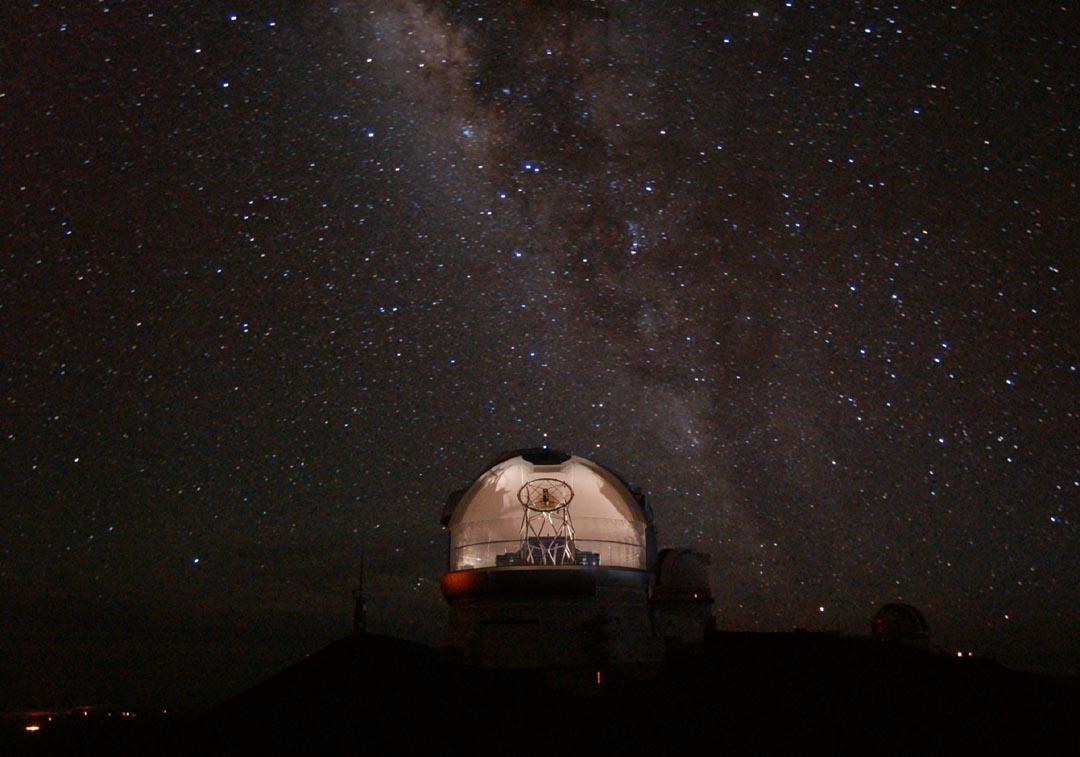
A Gemini Sky
翻訳エラー: Exception: 1 日にサービス translate を実行した回数が多すぎます。
原文(English)
Where will Gemini take us tonight? It is dusk and Gemini North, one of the largest telescopes on planet Earth, prepares to peer into the distant universe. Gemini's flexible 8.1-mirror has taken already effectively taken humanity to distant stars, nebulas, galaxies, and quasars, telling us about the geometry, composition, and evolution of our universe. The above picture is actually a composite of over 40 images taken while the Gemini dome rotated, later adding an image of the star field taken from the same location. The Gemini dome is not transparent -- it only appears so because it rotated during the exposures of this image. The constellations of Scorpius and Sagittarius can be seen above the dome, as well as the sweeping band of our Milky Way Galaxy, including the direction toward the Galactic center. Gemini North's twin, Gemini South, resides in Cerro Pachn, Chile. This night, 2003 August 19, Gemini North took us only into the outer Solar System, observing Pluto in an effort to better determine the composition of its thin atmosphere.
\ この感動を宇宙仲間にシェア /
宇宙をXでシェア
© NASA / APOD