
🚀 宇宙の記憶・カレンダー検索
🚀 象徴的な写真:
APOD第1回
🚀 創造の柱
🚀 スピリット火星着陸
🚀 ハッブル超深宇宙
🚀 地球へようこそ|ブルー・マーブル
🚀 エンケラドス
🚀 ベテルギウス
🚀 火星着陸
🚀 青い夕焼け
🚀 冥王星のハート
🚀 皆既日食
🚀 アースライズ再構築
🚀 ブラックホール
🚀 ウェッブ初画像
🚀 アポロ11着陸
APOD30周年(2025年6月16日)
翻訳エラー: Exception: 1 日にサービス translate を実行した回数が多すぎます。
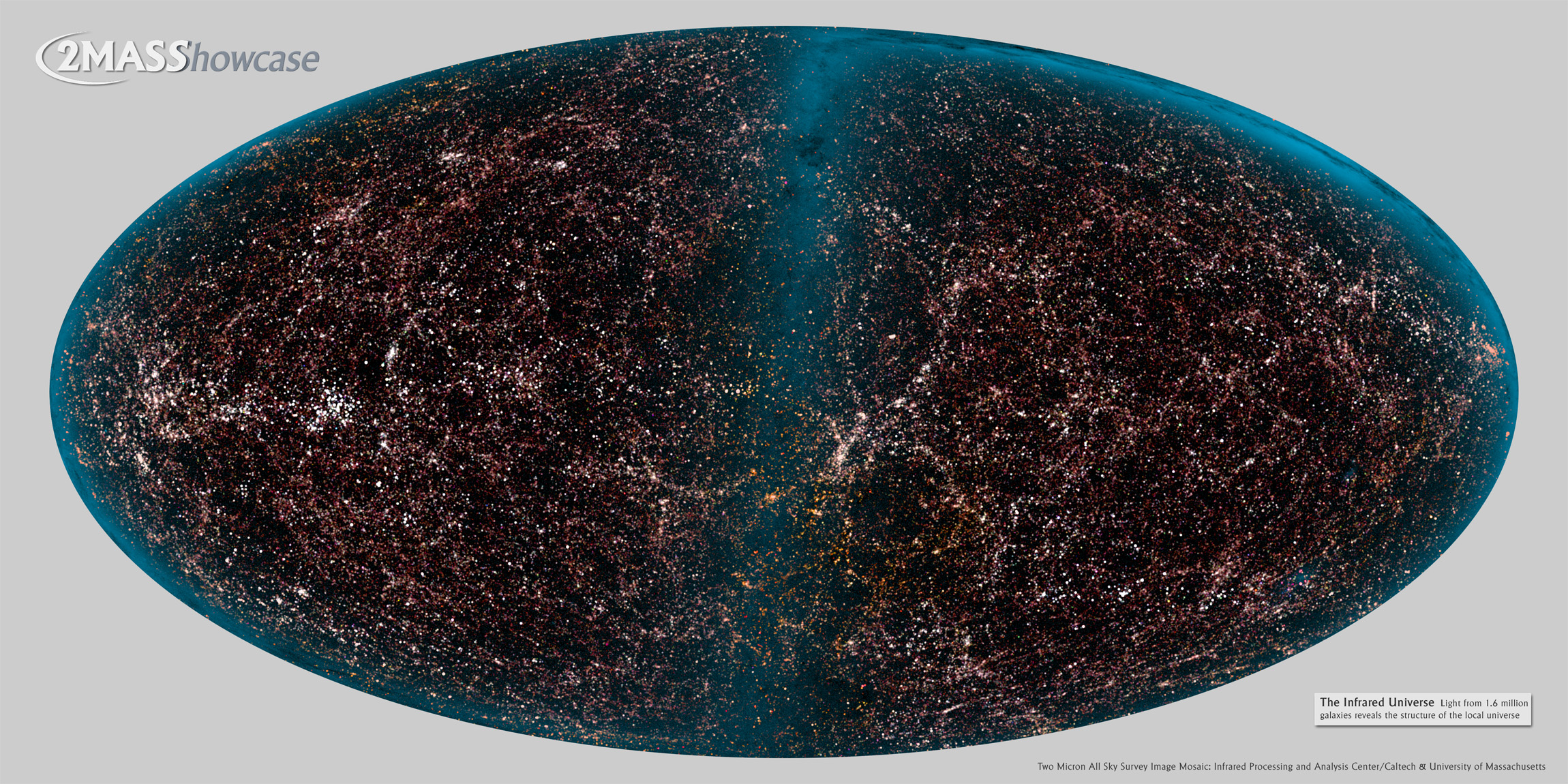
The 2MASS Galaxy Sky
翻訳エラー: Exception: 1 日にサービス translate を実行した回数が多すぎます。
原文(English)
Are the nearest galaxies distributed randomly? A plot of over one million of the brightest "extended sources" detected by the Two Micron All Sky Survey (2MASS) shows that they are not. The vast majority of these infrared extended sources are galaxies. Visible above is an incredible tapestry of structure that provides limits on how the universe formed and evolved. Many galaxies are gravitationally bound together to form clusters, which themselves are loosely bound into superclusters, which in turn are sometimes seen to align over even larger scale structures. In contrast, very bright stars inside our own Milky Way Galaxy cause the vertical blue sash.
\ この感動を宇宙仲間にシェア /
宇宙をXでシェア
©
2MASS,
T. H. Jarrett, J. Carpenter, & R. Hurt
/ APOD