
🚀 宇宙の記憶・カレンダー検索
🚀 象徴的な写真:
APOD第1回
🚀 創造の柱
🚀 スピリット火星着陸
🚀 ハッブル超深宇宙
🚀 地球へようこそ|ブルー・マーブル
🚀 エンケラドス
🚀 ベテルギウス
🚀 火星着陸
🚀 青い夕焼け
🚀 冥王星のハート
🚀 皆既日食
🚀 アースライズ再構築
🚀 ブラックホール
🚀 ウェッブ初画像
🚀 アポロ11着陸
APOD30周年(2025年6月16日)
翻訳エラー: Exception: 1 日にサービス translate を実行した回数が多すぎます。
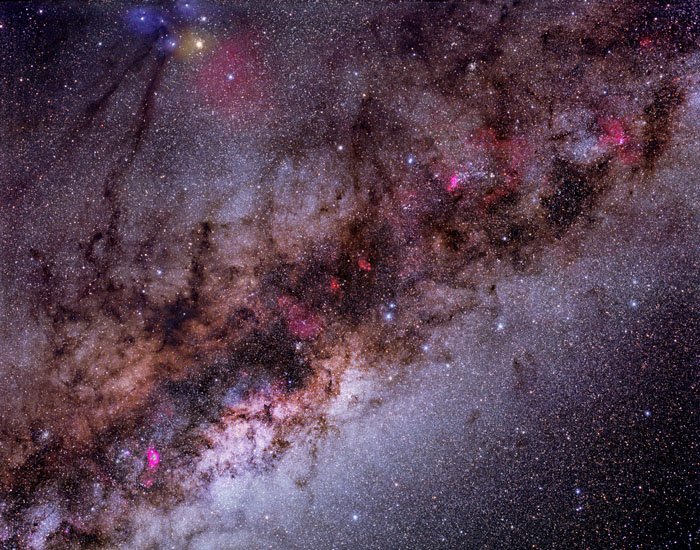
Our Galaxy in Stars, Gas, and Dust
翻訳エラー: Exception: 1 日にサービス translate を実行した回数が多すぎます。
原文(English)
The disk of our Milky Way Galaxy is home to hot nebulae, cold dust, and billions of stars. The red nebulae visible in the above contrast-enhanced picture are primarily emission nebulae, glowing clouds of hydrogen gas heated by nearby, bright, young stars. The blue nebulae are primarily reflection nebulae, clouds of gas and fine dust reflecting the light of nearby bright stars. Perhaps the most striking, though, are the areas of darkness, including the Pipe Nebula visible on the image top left. These are lanes of thick dust, many times containing relatively cold molecular clouds of gas. Dust is so plentiful that it obscures the Galactic Center in visible light, hiding its true direction until discovered early last century. The diffuse glow comes from billions of older, fainter stars like our Sun, which are typically much older than any of the nebulae. Most of the mass of our Galaxy remains in a form currently unknown.
\ この感動を宇宙仲間にシェア /
宇宙をXでシェア
©
John P. Gleason,
Steve Mandel
/ APOD