
🚀 宇宙の記憶・カレンダー検索
🚀 象徴的な写真:
APOD第1回
🚀 創造の柱
🚀 スピリット火星着陸
🚀 ハッブル超深宇宙
🚀 地球へようこそ|ブルー・マーブル
🚀 エンケラドス
🚀 ベテルギウス
🚀 火星着陸
🚀 青い夕焼け
🚀 冥王星のハート
🚀 皆既日食
🚀 アースライズ再構築
🚀 ブラックホール
🚀 ウェッブ初画像
🚀 アポロ11着陸
APOD30周年(2025年6月16日)
翻訳エラー: Exception: 1 日にサービス translate を実行した回数が多すぎます。
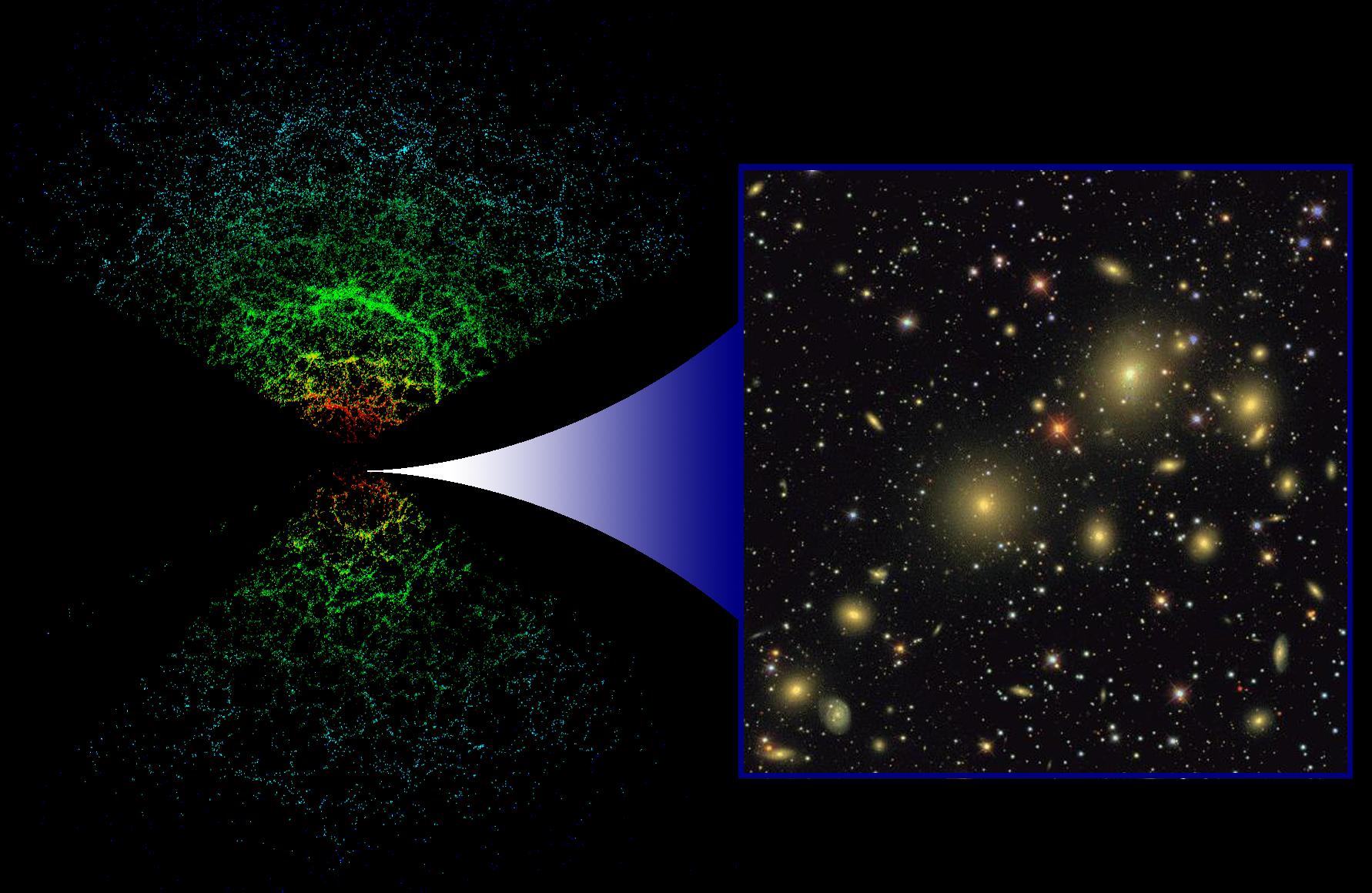
The SDSS 3D Universe Map
翻訳エラー: Exception: 1 日にサービス translate を実行した回数が多すぎます。
原文(English)
The latest map of the cosmos again indicates that dark matter and dark energy dominate our universe. The Sloan Digital Sky Survey (SDSS) is on its way to measuring the distances to over one million galaxies. Galaxies first identified on 2D images, like the one shown above on the right, have their distances measured to create the 3D map. The SDSS currently reports 3D information for over 200,000 galaxies, now rivaling the 3D galaxy-count of the Two-Degree Field sky map. The latest SDSS map, shown above on the left, could only show the galaxy distribution it does if the universe was composed and evolved a certain way. After trying to match many candidate universes to it, the Cinderella universe that best fits the above map has 5% atoms, 25% dark matter, and 70% dark energy. Such a universe was previously postulated because its rapid recent expansion can explain why distant supernovas are so dim, and its early evolution can explain the spot distribution on the very distant cosmic microwave background.
\ この感動を宇宙仲間にシェア /
宇宙をXでシェア
© NASA / APOD