
🚀 宇宙の記憶・カレンダー検索
🚀 象徴的な写真:
APOD第1回
🚀 創造の柱
🚀 スピリット火星着陸
🚀 ハッブル超深宇宙
🚀 地球へようこそ|ブルー・マーブル
🚀 エンケラドス
🚀 ベテルギウス
🚀 火星着陸
🚀 青い夕焼け
🚀 冥王星のハート
🚀 皆既日食
🚀 アースライズ再構築
🚀 ブラックホール
🚀 ウェッブ初画像
🚀 アポロ11着陸
APOD30周年(2025年6月16日)
赤外線で捉えた月食
Eclipsed Moon in Infrared
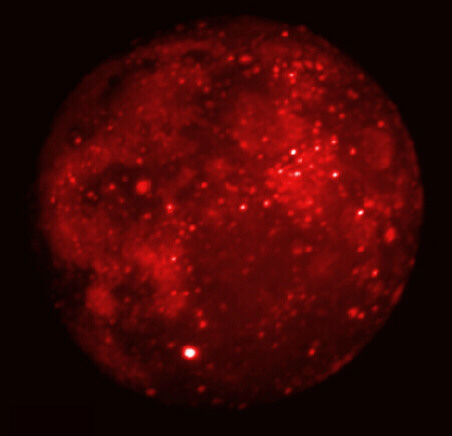
1996年9月の皆既月食は、曇天に見舞われた北米の多くの観測者を失望させた。しかし、ミッドコース宇宙実験(MSX)衛星は地球軌道から壮大な眺めを堪能し、搭載された赤外線望遠鏡SPIRIT IIIを用いて月食の間、繰り返し月を撮影した。上の画像は、70分間の皆既月食中に撮影された画像の一つで、月が地球の影に完全に覆われている様子を示している。赤外線は可視光線よりも波長が長く、人間には見えないが熱として感じられる。明るい部分は月面の暖かい領域、暗い部分は温度が低い領域を表している。中央左下にある最も明るい部分はティコ・クレーター、右上の暗い部分は危機の海である。SPIRIT IIIの一連の画像により、地質学的に異なる領域の冷却速度を測定し、月面の物理的特性を調査することが可能になった。
原文(English)
The total lunar eclipse of September 1996 disappointed many observers in North America who were cursed with cloudy skies. However, the Midcourse Space Experiment (MSX) satellite had a spectacular view from Earth orbit and SPIRIT III, an on board infrared telescope, was used to repeatedly image the moon during the eclipse. Above is one of the images taken during the 70 minute totality, the Moon completely immersed in the Earth's shadow. Infrared light has wavelengths longer than visible light - humans can not see it but feel it as heat. The bright spots correspond to the warm areas on the lunar surface, dark areas are cooler. The brightest spot below and left of center is the crater Tycho, the dark region at the upper right is the Mare Crisium. The series of SPIRIT III images allow the determination of cooling rates for geologically different areas, exploring the physical properties of the Moon's surface.
\ この感動を宇宙仲間にシェア /
宇宙をXでシェア
© NASA / APOD