
🚀 宇宙の記憶・カレンダー検索
🚀 象徴的な写真:
APOD第1回
🚀 創造の柱
🚀 スピリット火星着陸
🚀 ハッブル超深宇宙
🚀 地球へようこそ|ブルー・マーブル
🚀 エンケラドス
🚀 ベテルギウス
🚀 火星着陸
🚀 青い夕焼け
🚀 冥王星のハート
🚀 皆既日食
🚀 アースライズ再構築
🚀 ブラックホール
🚀 ウェッブ初画像
🚀 アポロ11着陸
APOD30周年(2025年6月16日)
中間極連星系
An Intermediate Polar Binary System
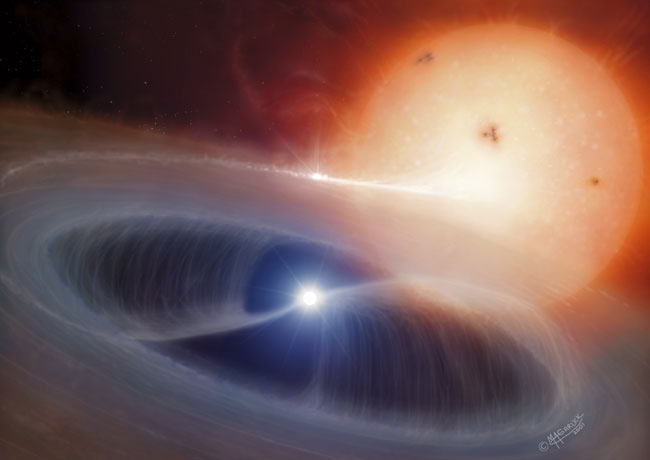
2 つの星がどのようにしてこのような奇妙で複雑な構造を作り出すことができるのでしょうか? ほとんどの星は多重星系に属しています。一部の星は近接連星系に属しており、一方の星からの物質が降着円盤でもう一方の星の周りを渦巻いています。しかし、中間極性星系に属する星はごくわずかです。中間極性星系は、磁場によって内側の降着円盤を大きく押し出し、物質が磁極に沿ってのみ落下する白色矮星を特徴とする系です。上に示したのは、DQ ヘルクレス系としても知られる中間極性星系の想像図です。手前の白色矮星は通常の星に非常に近いため、外側の大気を剥ぎ取っています。白色矮星が回転すると、落下するガスの柱も一緒に回転します。中間極性星という名前は、偏光星として知られる非円盤型連星系の中間のレベルで偏光した放出光の観測に由来しています。中間極性星は、激変星系の一種です。
原文(English)
How can two stars create such a strange and intricate structure? Most stars are members of multiple-star systems. Some stars are members of close binary systems where material from one star swirls around the other in an accretion disk. Only a handful of stars, however, are members of an intermediate polar, a system featuring a white dwarf star with a magnetic field that significantly pushes out the inner accretion disk, only allowing material to fall down its magnetic poles. Shown above is an artist's depiction of an intermediate polar system, also known as a DQ Hercules system. The foreground white dwarf is so close to the normal star that it strips away its outer atmosphere. As the white dwarf spins, the columns of infalling gas rotate with it. The name intermediate polar derives from observations of emitted light polarized at a level intermediate to non-disk binary systems known as polars. Intermediate polars are a type of cataclysmic variable star system.
\ この感動を宇宙仲間にシェア /
宇宙をXでシェア
© Mark Garlick
(Space-art) / APOD