
🚀 宇宙の記憶・カレンダー検索
🚀 象徴的な写真:
APOD第1回
🚀 創造の柱
🚀 スピリット火星着陸
🚀 ハッブル超深宇宙
🚀 地球へようこそ|ブルー・マーブル
🚀 エンケラドス
🚀 ベテルギウス
🚀 火星着陸
🚀 青い夕焼け
🚀 冥王星のハート
🚀 皆既日食
🚀 アースライズ再構築
🚀 ブラックホール
🚀 ウェッブ初画像
🚀 アポロ11着陸
APOD30周年(2025年6月16日)
火星の過去と現在
Mars Then and Now
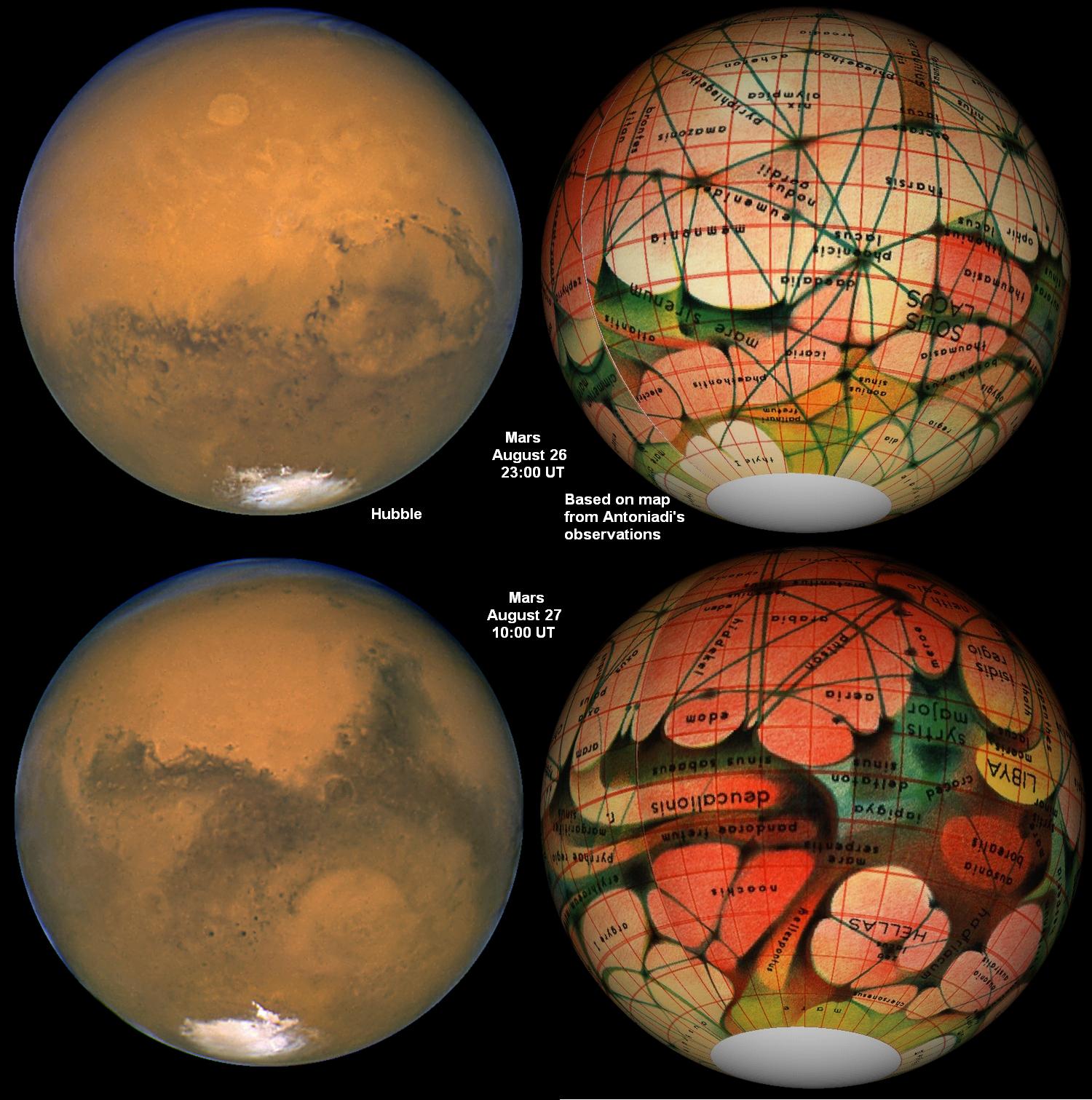
火星には運河があるのか? 1800年代後半の熱い議論の的となったこの問題で、パーシバル・ローウェルをはじめとする著名な天文学者たちは、火星に広範囲にわたる長くまっすぐな運河のシステムが存在すると主張しただけでなく、それを火星に知的生命体が存在する証拠として用いた。1894年の比較的接近した衝を利用して、左上のデジタルで拡大縮小された図のような図が作成された。上記の地図は元々ユージン・アントニアディによって作成され、ロイ・A・ギャラント著『火星探査』のためにローウェル・ヘスによって描き直されたものである。より現代では、最新の火星の衝により、ハッブル宇宙望遠鏡が同様の向きの画像を撮影することができた。2つの画像を比較すると、大きな地形は印象的に記録されているが、広範囲にわたる長くまっすぐな運河のシステムは存在しないことがわかる。火星を周回する衛星は現在、赤い惑星には確かに運河に似た地表地形が存在するが、それらは通常、以前主張されていたよりも小さく、湾曲しており、範囲も狭いことを決定的に示している。ノクティス・ラビリントゥスのような実際の峡谷系は、おそらく地表応力によって生じた亀裂である。
原文(English)
Does Mars have canals? A hot debate topic of the late 1800s, several prominent astronomers including Percival Lowell not only claimed to see an extensive system of long straight canals on Mars, but used them to indicate that intelligent life exists there. The relatively close opposition of 1894 was used to make drawings like the one digitally re-scaled on the above left. The above map was originally prepared by Eugene Antoniadi and redrawn by Lowell Hess for the book Exploring Mars, by Roy A. Gallant. In more modern times, the latest Mars opposition has allowed the Hubble Space Telescope to capture a picture of similar orientation. Comparison of the two images shows that large features were impressively recorded, but that an extensive system of long and straight canals just does not exist. Satellites orbiting Mars have now shown conclusively that the red planet does indeed have surface features similar to canals, but that these are usually smaller, curved, and less extensive than that previously claimed. Real canyon systems like Noctis Labyrinthus are most likely cracks caused by surface stress.
\ この感動を宇宙仲間にシェア /
宇宙をXでシェア
© Tom Ruen,
Eugene Antoniadi, Lowell Hess,
Roy A. Gallant,
HST,
NASA / APOD