
🚀 宇宙の記憶・カレンダー検索
🚀 象徴的な写真:
APOD第1回
🚀 創造の柱
🚀 スピリット火星着陸
🚀 ハッブル超深宇宙
🚀 地球へようこそ|ブルー・マーブル
🚀 エンケラドス
🚀 ベテルギウス
🚀 火星着陸
🚀 青い夕焼け
🚀 冥王星のハート
🚀 皆既日食
🚀 アースライズ再構築
🚀 ブラックホール
🚀 ウェッブ初画像
🚀 アポロ11着陸
APOD30周年(2025年6月16日)
ボイジャー探査機、90天文単位
Voyager at 90 AU
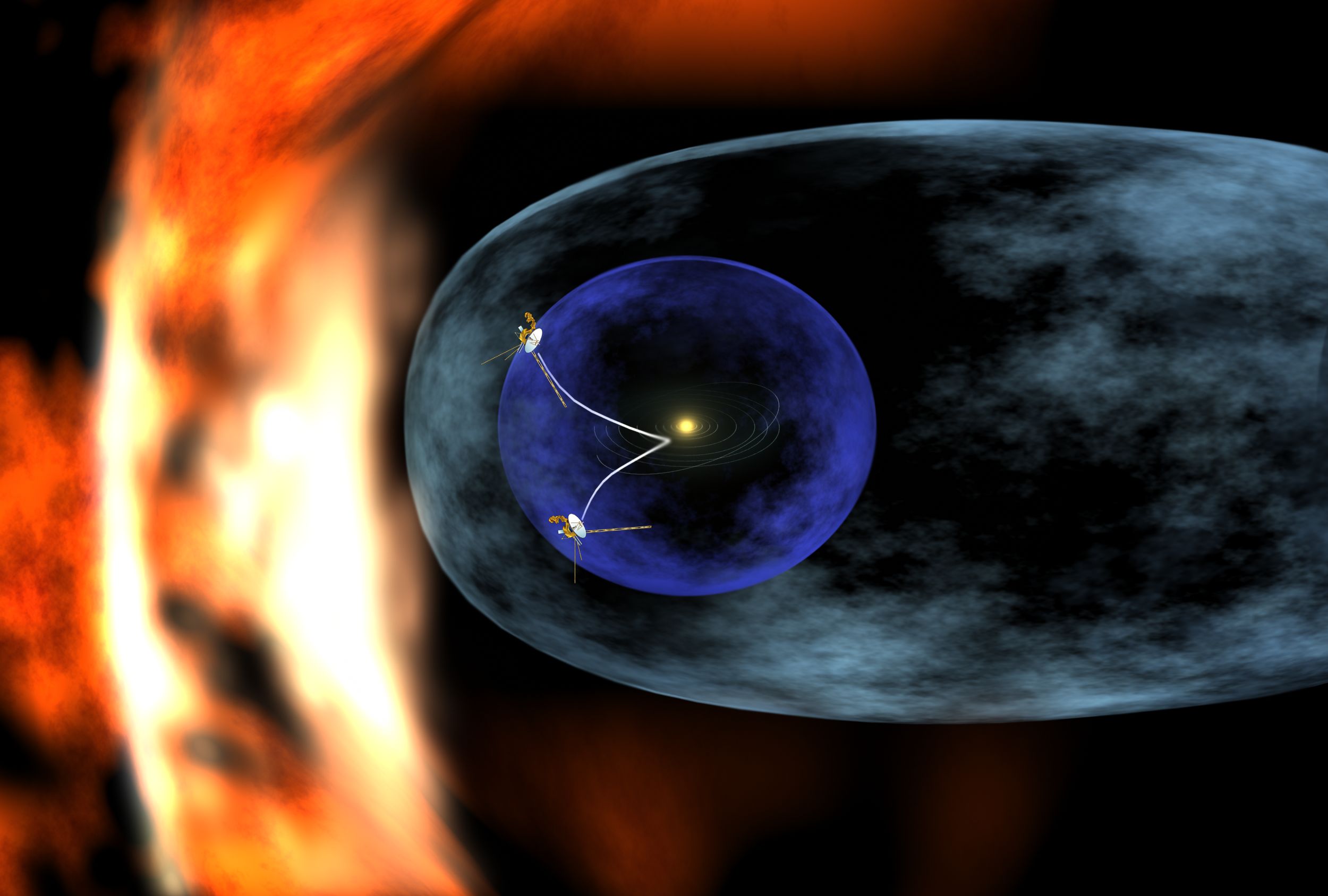
1977年に打ち上げられたボイジャー1号は現在、太陽から約12光時間、または90天文単位(AU)の距離にあり、人類が宇宙に送り出した最も遠い大使となっています。外惑星の軌道をはるかに超えたボイジャー1号は、太陽風と磁場が支配する領域である太陽圏の端付近の深宇宙領域に入りつつあると考えられています。議論を呼んでいるものの、現在も稼働している機器からの新たな結果により、探査機がついに太陽風の終端衝撃波と呼ばれる変動境界に遭遇している可能性が示唆されています。上に示した泡状の終端衝撃波は、太陽からの風が希薄な星間ガスにぶつかる際に急激に減速し、蓄積されることで発生します。さらに遠く、太陽圏界面の向こう側では、太陽風と星間ガスが混ざり合い始め、太陽圏が星間空間を移動することで、水面を進む船に例えられるバウショックが発生します。ボイジャー1号と2号は、いずれも2020年頃まで運用できるだけの電力と燃料を備えていると推定されている。両探査機は年間3天文単位以上の速度で恒星間空間へと向かって航行を続けている。
原文(English)
Launched in 1977, Voyager 1 is now about 12 light-hours or 90 astronomical units (AU) from the Sun, making this spacecraft humanity's most distant ambassador to the cosmos. Well beyond the orbits of the outer planets, Voyager 1 is believed to be entering the realm of deep space near the edge of the heliosphere, the region dominated by the solar wind and magnetic field. Causing some debate, new results from instruments still operating have given indications that the spacecraft could finally be encountering a fluctuating boundary known as the solar wind's termination shock. Illustrated above, the bubble-shaped termination shock is produced when the wind from the Sun slows dramatically and piles up as it runs in to the tenuous interstellar gas. Still farther out, beyond the heliopause, solar wind and interstellar gas begin to mix, while the heliosphere's motion through interstellar space creates a bow shock, analogous to a boat moving through water. Estimates are that both Voyager 1 and 2 have enough power and fuel to operate until about the year 2020. The spacecraft continue to coast toward interstellar space at over 3 AU per year.
\ この感動を宇宙仲間にシェア /
宇宙をXでシェア
© NASA / APOD