
🚀 宇宙の記憶・カレンダー検索
🚀 象徴的な写真:
APOD第1回
🚀 創造の柱
🚀 スピリット火星着陸
🚀 ハッブル超深宇宙
🚀 地球へようこそ|ブルー・マーブル
🚀 エンケラドス
🚀 ベテルギウス
🚀 火星着陸
🚀 青い夕焼け
🚀 冥王星のハート
🚀 皆既日食
🚀 アースライズ再構築
🚀 ブラックホール
🚀 ウェッブ初画像
🚀 アポロ11着陸
APOD30周年(2025年6月16日)
星々の群れ
A Flock of Stars
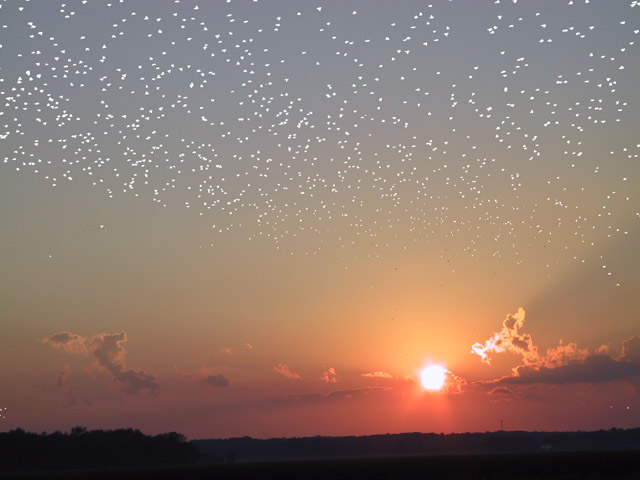
孤独な太陽は天の川銀河の外側の渦状腕付近に位置し、その10光年以内にはわずか数個の星しか見当たりません。しかし、もし太陽が銀河系の星団の中にあったとしたら、同じくらいの空間に何千もの星がひしめき合っているかもしれません。そんな星が密集した場所では、夜空は一体どんな光景になるのでしょうか?ロジャー・ホプキンスがアメリカ合衆国ニューヨーク州西部のフィンガーレイクス地方にあるモンテズマ国立野生生物保護区でこの写真を撮影した時、まさにこの考えに心を奪われました。彼は、穏やかな夕焼けを背景にムクドリの群れを撮影し、黒い鳥のシルエットを白く加工しました。こうして完成した写真は、星団の世界の上空に広がる満天の星空に迫る夜の魅惑的な光景を劇的に表現しています。
原文(English)
Only a few stars can be found within ten light-years of our lonely Sun, situated near an outer spiral arm of the Milky Way galaxy. But if the Sun were found within one of our galaxy's star clusters, thousands of stars might occupy a similar space. What would the night sky look like in such a densely packed stellar neighborhood? When Roger Hopkins took this picture at the Montezuma National Wildlife Refuge in the Finger Lakes region of western New York, USA, he was struck by this same notion. Appropriately, he had photographed a flock of starlings against the backdrop of a serene sunset. He then manipulated the image so that the black bird silhouettes were changed to white. The final picture dramatically suggests the tantalizing spectacle of approaching night in crowded skies above a cluster star world.
\ この感動を宇宙仲間にシェア /
宇宙をXでシェア
© Roger A. Hopkins / APOD