
🚀 宇宙の記憶・カレンダー検索
🚀 象徴的な写真:
APOD第1回
🚀 創造の柱
🚀 スピリット火星着陸
🚀 ハッブル超深宇宙
🚀 地球へようこそ|ブルー・マーブル
🚀 エンケラドス
🚀 ベテルギウス
🚀 火星着陸
🚀 青い夕焼け
🚀 冥王星のハート
🚀 皆既日食
🚀 アースライズ再構築
🚀 ブラックホール
🚀 ウェッブ初画像
🚀 アポロ11着陸
APOD30周年(2025年6月16日)
プロトンオーロラ
A Proton Aurora
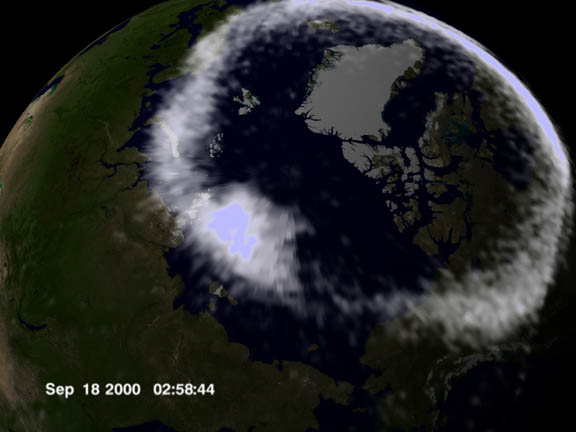
オーロラは何でできているのでしょうか?太陽活動によって引き起こされる通常のオーロラは、高速で移動する電子と地球の上層大気中の酸素と窒素との衝突によって発生します。電子は、地球の磁場によって制御される宇宙領域である磁気圏からやってきます。励起された酸素と窒素分子が低エネルギー状態に戻る際に光を放出し、それがオーロラの光として観測されます。しかし、オーロラはより重い陽子との衝突によって引き起こされることもあり、強い紫外線を放出する、よりエネルギーの高い現象となります。さらに、陽子は一時的に電子を捕獲し、自ら光を放出することもあります。上に示したのは、IMAGE衛星によって記録された、そのような陽子オーロラです。特徴的なのは、地球の北磁極の周りのオーロラ発光の環の中に埋め込まれた、画像の中心付近の明るい点です。太陽風の陽子のほとんどは、地球の磁場によって遠く離れた場所で完全に偏向されるため、オーロラを引き起こすために地球に到達することはありません。オーロラの環に見られる明るい点は、地球の磁場に特に深い亀裂が生じていることを示しており、そこでは陽子が太陽と地球の間の一時的に繋がった領域に沿って、比較的偏向されることなく流れ、地球の電離層に衝突したと考えられる。
原文(English)
What are auroras made out of? Triggered by solar activity, normal auroras are caused by collisions between fast-moving electrons and the oxygen and nitrogen in Earth's upper atmosphere. The electrons come from the magnetosphere, the region of space controlled by Earth's magnetic field. As the excited oxygen and nitrogen molecules return to their low energy state, they emit light, seen as the auroral glow. Sometimes, however, auroras can be caused by collisions with heavier protons, causing a more energetic display with strong ultraviolet emission. In addition, protons can temporarily capture an electron and emit light for themselves. Such a proton aurora is seen above, recorded by the IMAGE satellite. A special feature is the bright spot near picture center, embedded in a ring of auroral emission around the north magnetic pole of planet Earth. Most solar wind protons never reach the Earth to cause auroras because they are completely deflected away at a great distance by the Earth's magnetic field. The bright spot in the auroral ring indicates a particularly deep crack in the Earth's magnetic field where protons were able to flow along a temporarily connected region between the Sun and the Earth, relatively undeflected, until they impacted the Earth's ionosphere.
\ この感動を宇宙仲間にシェア /
宇宙をXでシェア
© NASA / APOD