
🚀 宇宙の記憶・カレンダー検索
🚀 象徴的な写真:
APOD第1回
🚀 創造の柱
🚀 スピリット火星着陸
🚀 ハッブル超深宇宙
🚀 地球へようこそ|ブルー・マーブル
🚀 エンケラドス
🚀 ベテルギウス
🚀 火星着陸
🚀 青い夕焼け
🚀 冥王星のハート
🚀 皆既日食
🚀 アースライズ再構築
🚀 ブラックホール
🚀 ウェッブ初画像
🚀 アポロ11着陸
APOD30周年(2025年6月16日)
NGC 6369:小さな幽霊星雲
NGC 6369: The Little Ghost Nebula
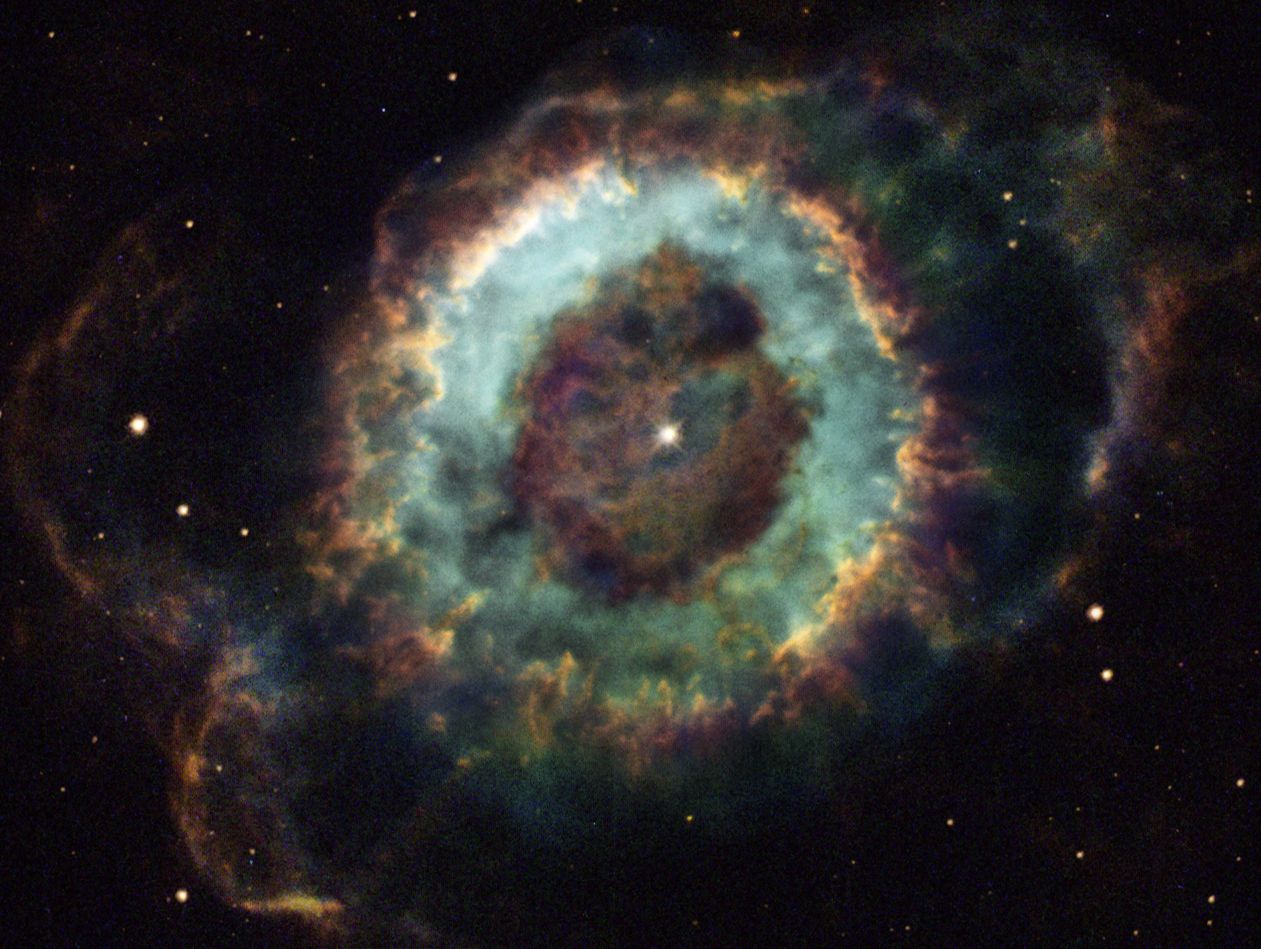
NGC 6369としてカタログ化されているこの美しい惑星状星雲は、18世紀の天文学者ウィリアム・ハーシェルが望遠鏡を使ってへびつかい座を観測した際に発見されました。丸く惑星のような形をしたこの星雲は、比較的淡いため、「小さな幽霊星雲」という愛称で親しまれています。惑星状星雲は一般的に惑星とは全く関係がなく、太陽のような恒星が寿命の終わりに外層が宇宙空間に膨張し、中心部が収縮して白色矮星になる際に形成されます。中心付近に見える変容した白色矮星は紫外線波長で強く放射し、膨張する星雲の輝きを支えています。ハッブル宇宙望遠鏡のデータから作成されたこの美しいカラー画像には、NGC 6369の驚くほど複雑な構造が明らかになっています。この星雲の主環構造は直径約1光年で、電離した酸素、水素、窒素原子の輝きはそれぞれ青、緑、赤に輝いている。2000光年以上離れたところにあるこの小幽霊星雲は、約50億年後に自らも美しい惑星状星雲を形成するとされる太陽の未来を垣間見せてくれる。
原文(English)
This pretty planetary nebula, cataloged as NGC 6369, was discovered by 18th century astronomer William Herschel as he used a telescope to explore the medicinal constellation Ophiucus. Round and planet-shaped, the nebula is also relatively faint and has acquired the popular moniker of Little Ghost Nebula. Planetary nebulae in general are not at all related to planets, but instead are created at the end of a sun-like star's life as its outer layers expand into space while the star's core shrinks to become a white dwarf. The transformed white dwarf star, seen near the center, radiates strongly at ultraviolet wavelengths and powers the expanding nebula's glow. Surprisingly complex details and structures of NGC 6369 are revealed in this delightful color image composed from Hubble Space Telescope data. The nebula's main ring structure is about a light-year across and the glow from ionized oxygen, hydrogen, and nitrogen atoms are colored blue, green, and red respectively. Over 2,000 light-years away, the Little Ghost Nebula offers a glimpse of the fate of our Sun, which should produce its own pretty planetary nebula only about 5 billion years from now.
\ この感動を宇宙仲間にシェア /
宇宙をXでシェア
© NASA / APOD