
🚀 宇宙の記憶・カレンダー検索
🚀 象徴的な写真:
APOD第1回
🚀 創造の柱
🚀 スピリット火星着陸
🚀 ハッブル超深宇宙
🚀 地球へようこそ|ブルー・マーブル
🚀 エンケラドス
🚀 ベテルギウス
🚀 火星着陸
🚀 青い夕焼け
🚀 冥王星のハート
🚀 皆既日食
🚀 アースライズ再構築
🚀 ブラックホール
🚀 ウェッブ初画像
🚀 アポロ11着陸
APOD30周年(2025年6月16日)
一風変わったオリオン座
An Orion of a Different Color
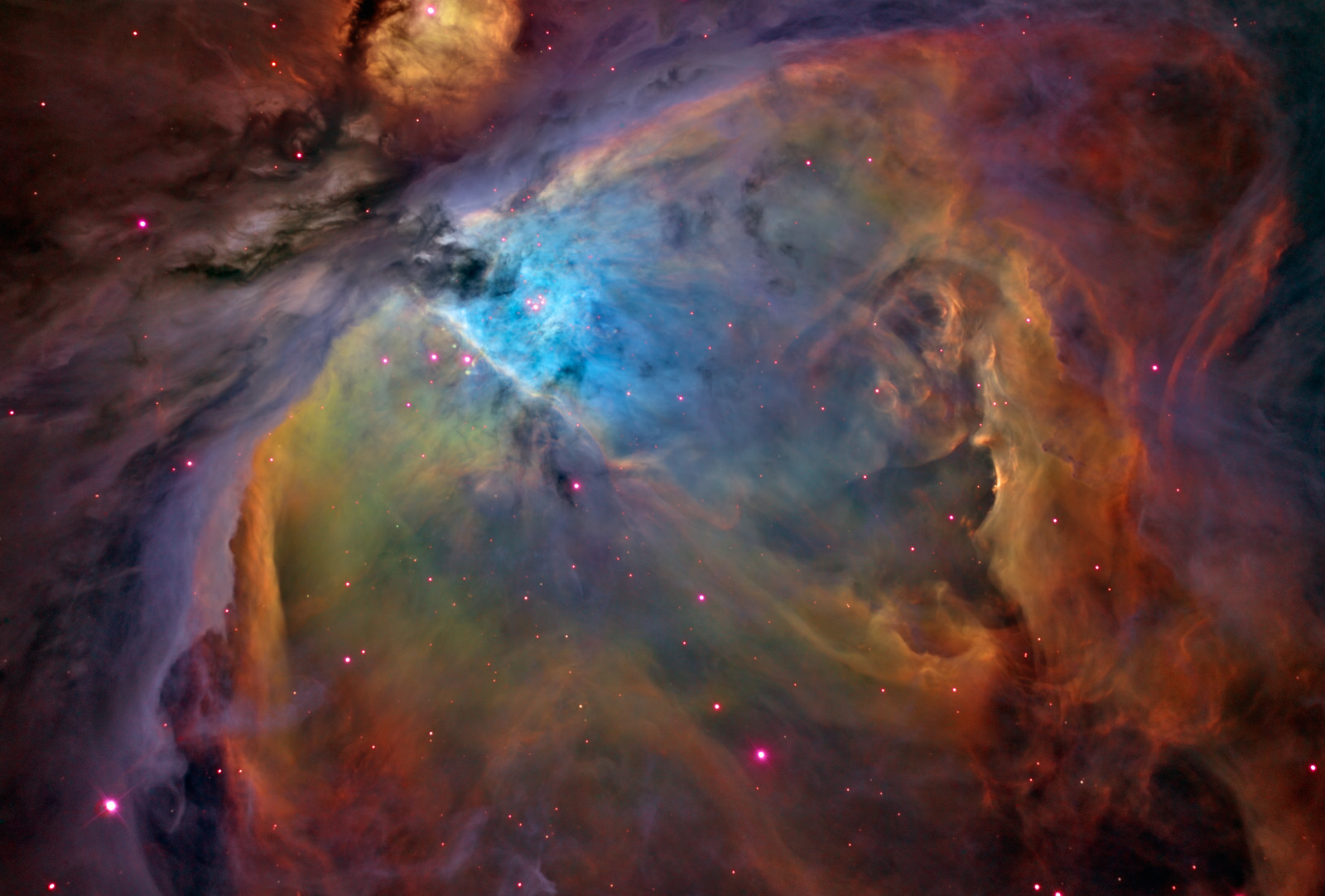
今夜空を見上げてみてください。高性能の望遠鏡を使っても、これほど素晴らしい光景に出会えることはないでしょう。しかし、これはオリオン星雲として知られる壮大な星形成領域という、見慣れた天体です。この印象的な画像は、それぞれ異なる輝線を記録するように設計された3つの異なるフィルターを通して撮影された画像を合成したものです。これらの輝線とは、希薄な星雲ガスの中で輝く硫黄、酸素、水素原子からの光です。このような低密度では、硫黄と水素原子は赤色を発し、酸素は緑色に輝きます。最終画像でそれぞれの寄与を区別するために、硫黄には赤、水素には緑、酸素には青が割り当てられました。これは、他の天体星雲のカラーマップ画像でも使用されている配色です。結果として、肉眼で見るものとは大きく異なりますが、この画像は美しく、また、近くの星形成領域内の元素や状態を捉えるという点で、科学的にも非常に価値のあるものです。
原文(English)
Look up into the sky tonight, and even with a good telescope you won't come across a sight quite like this one. It is a familiar object though, the grand stellar nursery known as the Orion Nebula. But the striking picture combines images taken through three separate filters, each designed to record different emission lines - light from Sulfur, Oxygen, and Hydrogen atoms glowing in the tenuous nebular gas. At such low densities, Sulfur and Hydrogen atoms emit red colors while Oxygen glows green. To distinguish their contributions in the final image, Sulfur was assigned to red, Hydrogen to green, and Oxygen to blue, a color scheme used in mapped-color images of other astronomical nebulae as well. While the result is very different from what the eye might see, the image is still both beautiful and scientifically valuable, tracing elements and conditions within the nearby star forming region.
\ この感動を宇宙仲間にシェア /
宇宙をXでシェア
© Russell Croman / APOD