
🚀 宇宙の記憶・カレンダー検索
🚀 象徴的な写真:
APOD第1回
🚀 創造の柱
🚀 スピリット火星着陸
🚀 ハッブル超深宇宙
🚀 地球へようこそ|ブルー・マーブル
🚀 エンケラドス
🚀 ベテルギウス
🚀 火星着陸
🚀 青い夕焼け
🚀 冥王星のハート
🚀 皆既日食
🚀 アースライズ再構築
🚀 ブラックホール
🚀 ウェッブ初画像
🚀 アポロ11着陸
APOD30周年(2025年6月16日)
正午のセドナ
Sedna at Noon
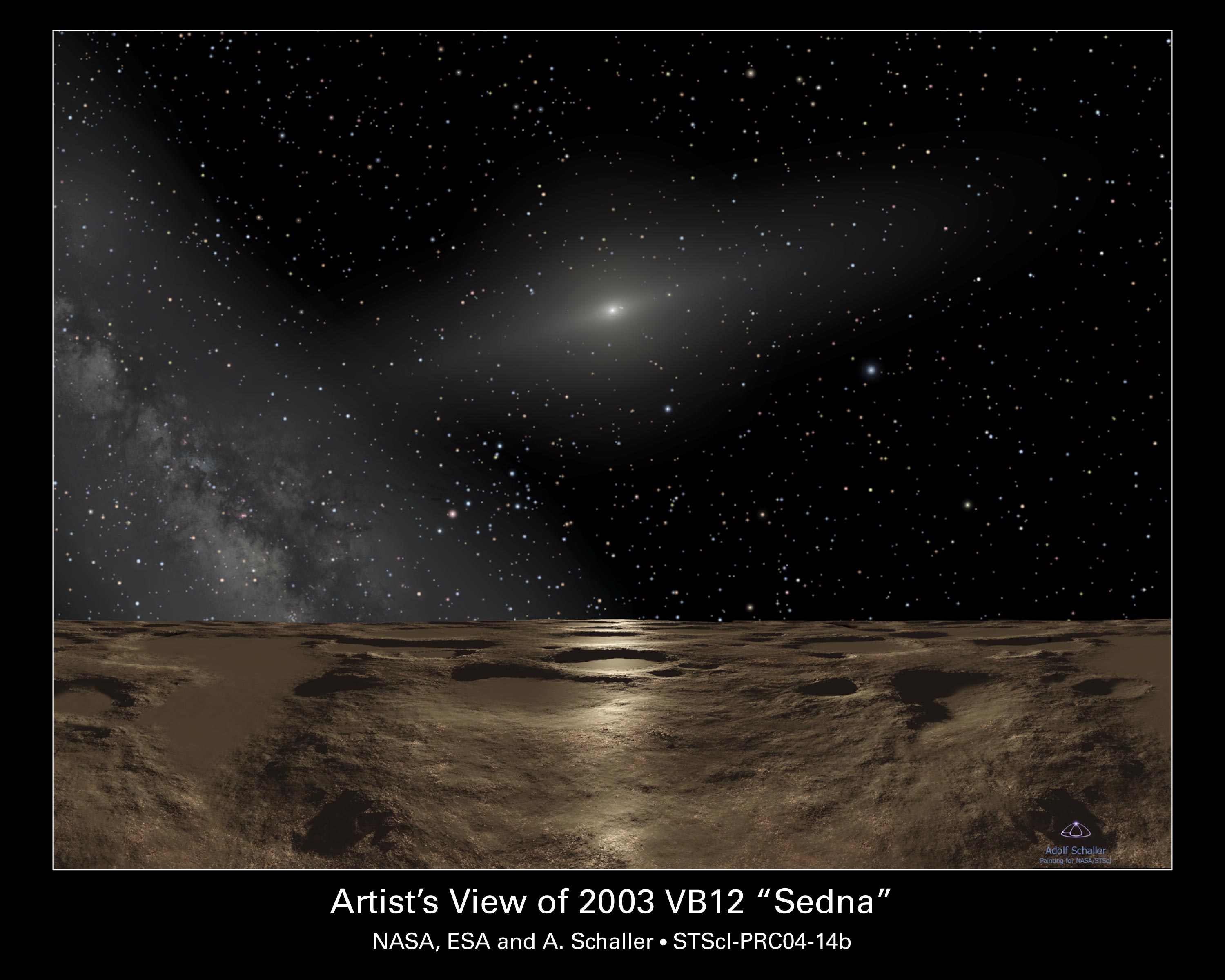
太陽系で最も遠い既知の準惑星であるセドナに立つと、正午の太陽の眺めは、おそらくこのようになるでしょう。この絵は、芸術家による劇的な想像図で、太陽が近くの地平線の上に、塵に覆われた黄道面に浮かぶ明るい星として描かれています。塵に散乱された太陽光の中には、地球を含む、より馴染みのある太陽系の天体が見えます。しかし、地球は約130億キロメートル(80億マイル)離れているため、双眼鏡か小型望遠鏡でしか見ることができません。セドナの暗い昼間の空では、正午の太陽に加えて、左側の荒涼とした赤みがかった地形の上に浮かぶ、かすかな星々と、視界を遮る天の川の塵の雲も見られます。セドナから空を観察する人にとって、すべての惑星は内側の軌道を回っており、セドナの空では太陽の近くにとどまります。もちろん、地上の天文学者にとって、内惑星である金星と水星も太陽の近くに位置しており、金星は6月8日に太陽面を横切るという珍しい現象が予定されている。
原文(English)
Standing on Sedna - the solar system's most distant known planetoid - your view of the Sun at high noon might look something like this. An artist's dramatic vision, the picture shows the Sun suspended above the nearby horizon as a bright star immersed in the dusty ecliptic plane. Within the dust-scattered sunlight are more familiar members of the solar system, including planet Earth. But at a distance of about 13 billion kilometers (8 billion miles) Earth would only be visible in binoculars or a small telescope. In Sedna's dark, daytime skies, the noonday Sun is also joined by the faint stars and obscuring dust clouds of the Milky Way, suspended on the left above stark, ruddy terrain. For Sedna-based sky gazers, all planets have interior orbits and would remain close to the Sun in Sedna's skies. Of course, for earthbound astronomers, interior planets Venus and Mercury also remain near the Sun, with Venus scheduled for a rare crossing of the solar disc on June 8.
\ この感動を宇宙仲間にシェア /
宇宙をXでシェア
© NASA / APOD