
🚀 宇宙の記憶・カレンダー検索
🚀 象徴的な写真:
APOD第1回
🚀 創造の柱
🚀 スピリット火星着陸
🚀 ハッブル超深宇宙
🚀 地球へようこそ|ブルー・マーブル
🚀 エンケラドス
🚀 ベテルギウス
🚀 火星着陸
🚀 青い夕焼け
🚀 冥王星のハート
🚀 皆既日食
🚀 アースライズ再構築
🚀 ブラックホール
🚀 ウェッブ初画像
🚀 アポロ11着陸
APOD30周年(2025年6月16日)
水銀斑点
Mercury Spotting
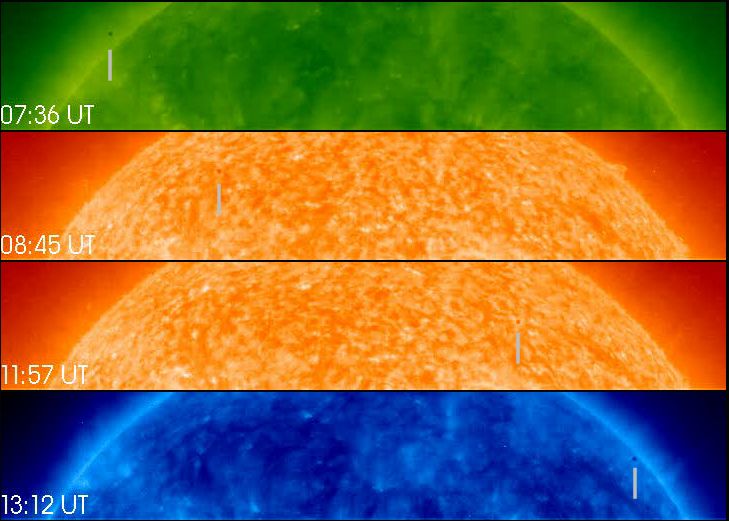
惑星を見つけられますか?太陽系最内惑星である水星の小さな円盤は、2003年5月7日、地球付近から見ると、巨大な太陽面の前を約5時間かけて横切りました。ヨーロッパ、アフリカ、アジア、オーストラリアの観測者にとっては、太陽は通過中ずっと地平線上にあり、太陽を観測するSOHO宇宙船にとっては地平線は全く問題になりませんでした。SOHOの極端紫外線カメラで撮影されたこれら4枚の画像では、水星は暗い点として見え、左から右(上段から下段)へと移動しています。パネルの擬似カラーは、太陽の可視表面より上の領域を強調する極端紫外線の異なる波長に対応しています。これは21世紀中に起こる14回の水星の太陽面通過の最初のものですが、次に起こる同様の現象は、今週火曜日に起こるはるかに稀な金星の太陽面通過です。水星を見つけるのに助けが必要ですか?画像をクリックしてください。速報:金星が火曜日に太陽面を横切ります
原文(English)
Can you spot the planet? The diminutive disk of Mercury, the solar system's innermost planet, spent about five hours crossing in front of the enormous solar disk on 2003 May 7, as viewed from the general vicinity of planet Earth. The Sun was above the horizon during the entire transit for observers in Europe, Africa, Asia, or Australia, and the horizon was certainly no problem for the sun-staring SOHO spacecraft. Seen as a dark spot, Mercury progresses from left to right (top panel to bottom) in these four images from SOHO's extreme ultraviolet camera. The panels' false-colors correspond to different wavelengths in the extreme ultraviolet which highlight regions above the Sun's visible surface. This was the first of 14 transits of Mercury which will occur during the 21st century, but the next similar event will be a much more rare transit of Venus this coming Tuesday. Need help spotting Mercury? Just click on the picture. News flash: Venus to cross the Sun on Tuesday
\ この感動を宇宙仲間にシェア /
宇宙をXでシェア
© NASA / APOD