
🚀 宇宙の記憶・カレンダー検索
🚀 象徴的な写真:
APOD第1回
🚀 創造の柱
🚀 スピリット火星着陸
🚀 ハッブル超深宇宙
🚀 地球へようこそ|ブルー・マーブル
🚀 エンケラドス
🚀 ベテルギウス
🚀 火星着陸
🚀 青い夕焼け
🚀 冥王星のハート
🚀 皆既日食
🚀 アースライズ再構築
🚀 ブラックホール
🚀 ウェッブ初画像
🚀 アポロ11着陸
APOD30周年(2025年6月16日)
金星と彩層
Venus and the Chromosphere
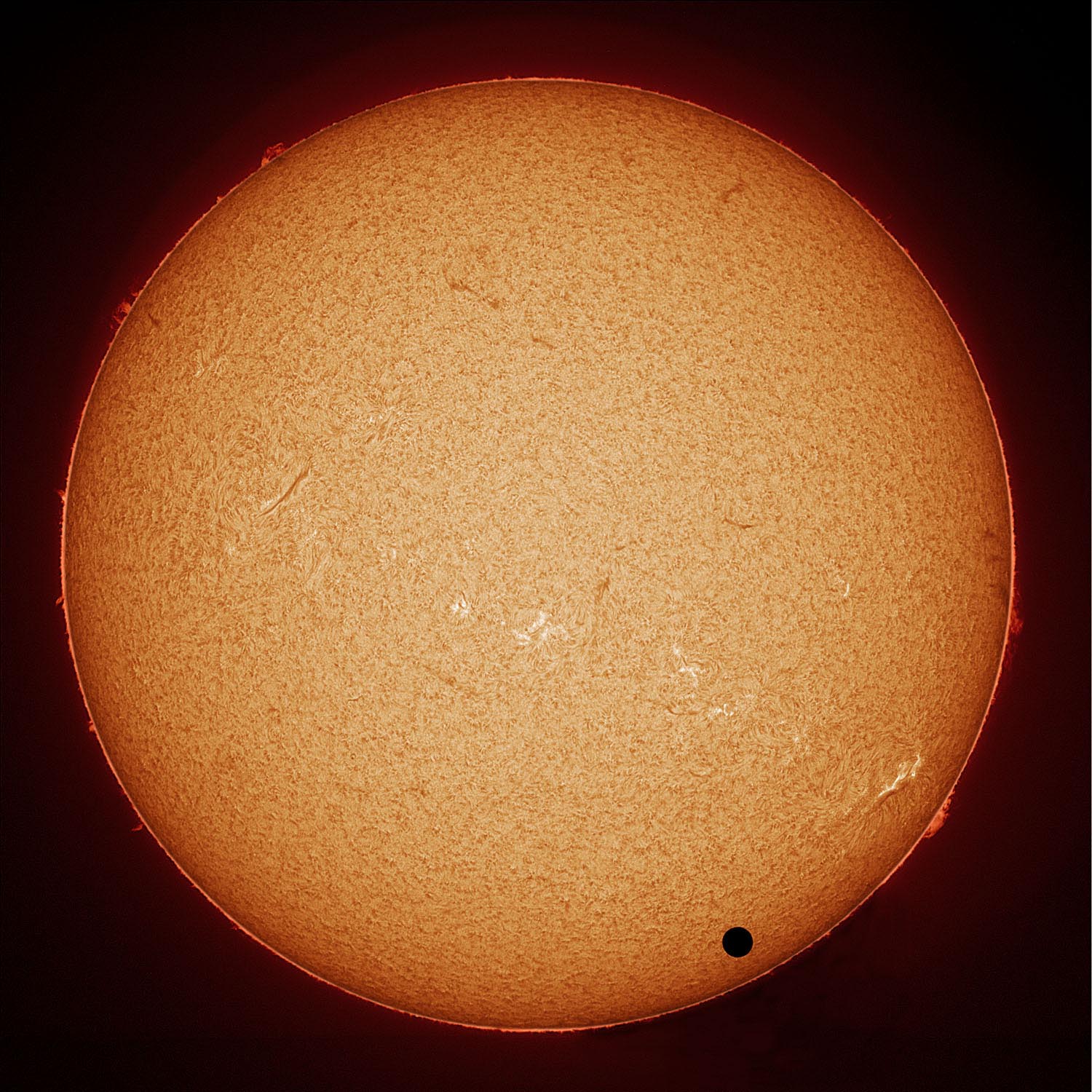
ドイツのシュトゥットガルトから2004年の金星の太陽面通過を観測していた天文学者ステファン・ザイプは、太陽のこの魅力的で詳細な画像を撮影した。太陽の縁に沿ってスピキュールやプロミネンスが見られる明るい太陽円盤を背景に、細胞や暗いフィラメントのネットワークが浮かび上がっているこの望遠鏡写真は、Hαフィルターを通して撮影された。このフィルターは水素原子からの赤い光だけを狭く透過し、太陽の彩層、つまり太陽の光球、つまり通常見える表面のすぐ上にある太陽大気の領域を強調する。ここでは、金星の暗い円盤が巨大な黒点を模倣しているように見えるが、少し丸すぎるように見える。しかし、このようなHα画像では、黒点領域は通常、太陽彩層上の明るい斑点(プラージュと呼ばれる)によって支配されている。
原文(English)
joying the 2004 Transit of Venus from Stuttgart, Germany, astronomer Stefan Seip recorded this fascinating, detailed image of the Sun. Revealing a network of cells and dark filaments against a bright solar disk with spicules and prominences along the Sun's limb, his telescopic picture was taken through an H-alpha filter. The filter narrowly transmits only the red light from hydrogen atoms and emphasizes the solar chromosphere -- the region of the Sun's atmosphere immediately above its photosphere or normally visible surface. Here, the dark disk of Venus seems to be imitating a giant sunspot that looks perhaps a little too round. But in H-alpha pictures like this one, sunspot regions are usually dominated by bright splotches (called plages) on the solar chromosphere.
\ この感動を宇宙仲間にシェア /
宇宙をXでシェア
© Stefan Seip / APOD