
🚀 宇宙の記憶・カレンダー検索
🚀 象徴的な写真:
APOD第1回
🚀 創造の柱
🚀 スピリット火星着陸
🚀 ハッブル超深宇宙
🚀 地球へようこそ|ブルー・マーブル
🚀 エンケラドス
🚀 ベテルギウス
🚀 火星着陸
🚀 青い夕焼け
🚀 冥王星のハート
🚀 皆既日食
🚀 アースライズ再構築
🚀 ブラックホール
🚀 ウェッブ初画像
🚀 アポロ11着陸
APOD30周年(2025年6月16日)
ホーグの観測対象:奇妙な環状銀河
Hoag's Object: A Strange Ring Galaxy
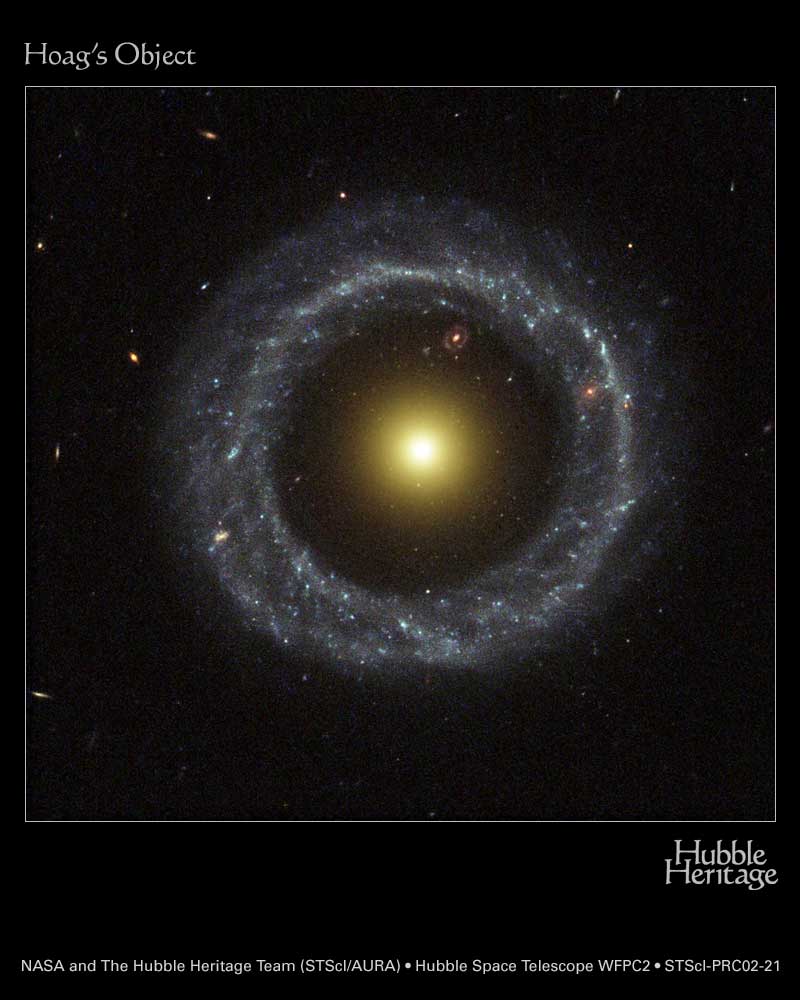
これは銀河が1つなのか、それとも2つなのか?この疑問は、1950年に天文学者のアート・ホーグがこの珍しい銀河外天体を偶然発見したことから浮上しました。外側には明るい青い星が支配的なリングがあり、中心付近にはおそらくはるかに古い、はるかに赤い星の球体があります。この2つの間には、ほぼ完全に暗いように見える隙間があります。ホーグの天体がどのように形成されたかは未だ不明ですが、同様の天体が特定され、まとめてリング銀河の一種として分類されています。起源に関する仮説には、数十億年前の銀河の衝突と、異常な形状のコアが関与する摂動的な重力相互作用が含まれます。2001年7月にハッブル宇宙望遠鏡によって撮影された上記の写真は、ホーグの天体のこれまでにない詳細を明らかにし、より深い理解をもたらす可能性があります。ホーグの天体は、約10万光年にわたって広がり、へび座の方向に約6億光年離れたところにあります。偶然にも、その隙間(だいたい1時方向)には、おそらくはるか遠くにあると思われる別の環状銀河が見える。
原文(English)
Is this one galaxy or two? This question came to light in 1950 when astronomer Art Hoag chanced upon this unusual extragalactic object. On the outside is a ring dominated by bright blue stars, while near the center lies a ball of much redder stars that are likely much older. Between the two is a gap that appears almost completely dark. How Hoag's Object formed remains unknown, although similar objects have now been identified and collectively labeled as a form of ring galaxy. Genesis hypotheses include a galaxy collision billions of years ago and perturbative gravitational interactions involving an unusually shaped core. The above photo taken by the Hubble Space Telescope in July 2001 reveals unprecedented details of Hoag's Object and may yield a better understanding. Hoag's Object spans about 100,000 light years and lies about 600 million light years away toward the constellation of Serpens. Coincidentally, visible in the gap (at about one o'clock) is yet another ring galaxy that likely lies far in the distance.
\ この感動を宇宙仲間にシェア /
宇宙をXでシェア
© NASA / APOD