
🚀 宇宙の記憶・カレンダー検索
🚀 象徴的な写真:
APOD第1回
🚀 創造の柱
🚀 スピリット火星着陸
🚀 ハッブル超深宇宙
🚀 地球へようこそ|ブルー・マーブル
🚀 エンケラドス
🚀 ベテルギウス
🚀 火星着陸
🚀 青い夕焼け
🚀 冥王星のハート
🚀 皆既日食
🚀 アースライズ再構築
🚀 ブラックホール
🚀 ウェッブ初画像
🚀 アポロ11着陸
APOD30周年(2025年6月16日)
セドナシナリオ
The Sedna Scenario
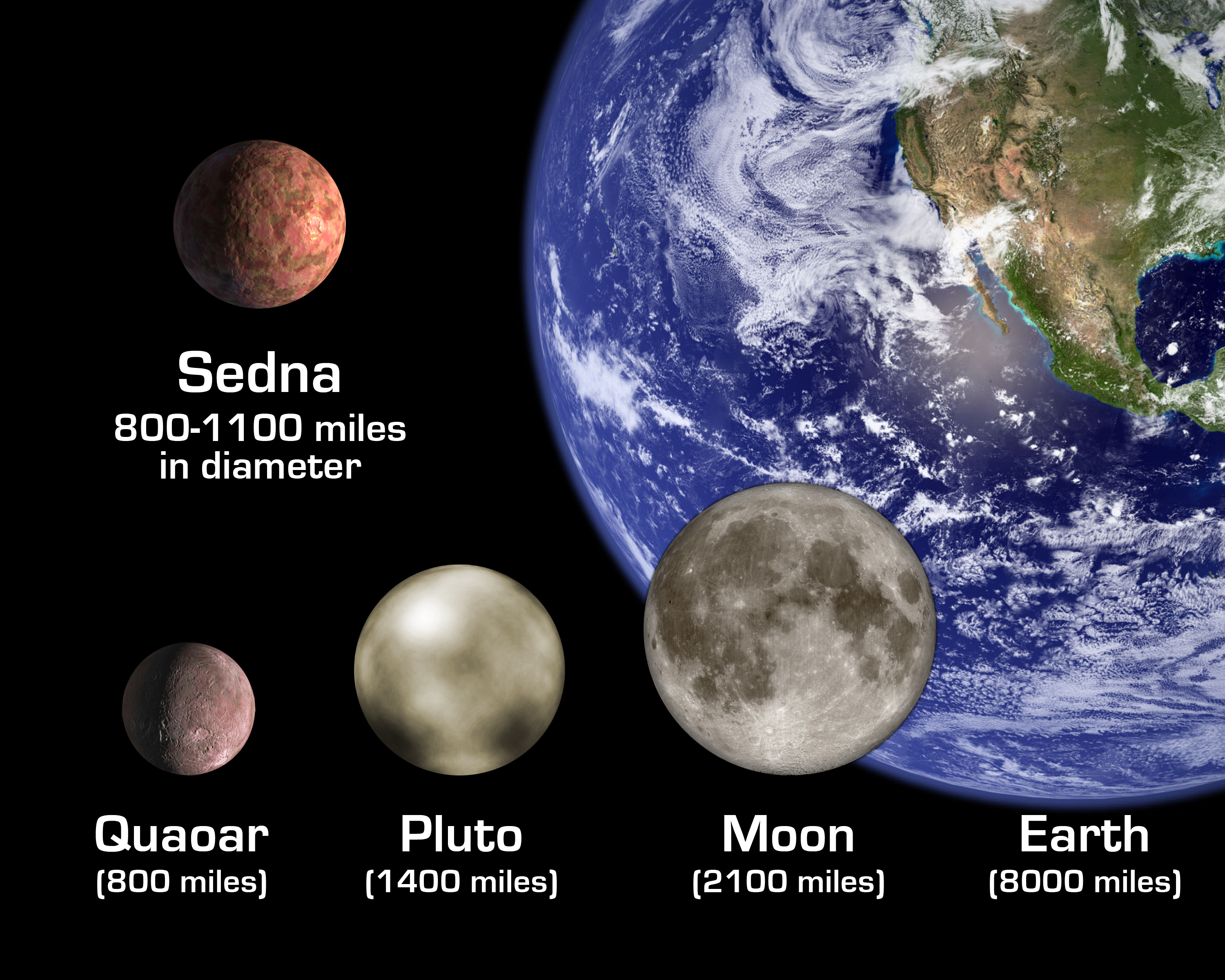
太陽を周回する既知の天体の中で最も遠いセドナ(別名2003 VB12)の発見は、謎を提起している。冥王星の軌道は平均して半径約40AUである。AU(天文単位)は地球と太陽の間の距離である。しかし、セドナの偏心軌道で最も近い地点は75AU以内には入らず、最も遠い地点は1,000AU近くまで広がっている。では、セドナのような大きな天体がどのようにしてこれほど遠くまで移動したのだろうか?天文学者のアレッサンドロ・モルビデッリとハロルド・レビソンは、コンピューターシミュレーションでこの問題を検証し、セドナは現在の位置で形成されたのではなく、他の太陽系天体との遭遇によって移動したわけでもないと示唆している。むしろ、セドナが現在の軌道にあるのは、別の恒星との遭遇による可能性が高いと彼らは考えている。あるシナリオでは、セドナのような天体は、太陽系形成期に太陽系近くを通過する太陽サイズの恒星の重力によって、より近い軌道から引きずり出されたと考えられています。あるいは、セドナは全く別の恒星系から来た物質から形成され、初期の頃にずっと小さな恒星と遭遇した際に捕獲された可能性もあります。セドナ形成に関するこれらの恒星遭遇シナリオはどちらも、太陽自体が古代の高密度な星団で誕生したという考えと矛盾しません。
原文(English)
The discovery of Sedna (aka 2003 VB12), the most distant known object orbiting the Sun, presents a mystery. Pluto's orbit averages about 40 AU in radius, where an AU (Astronomical Unit) is the Earth-Sun distance. But the closest point in Sedna's eccentric orbit scarcely comes within 75 AU, while its farthest point extends to nearly 1,000 AU. So how did something as large as Sedna get so far out there? Exploring the problem with computer simulations, astronomers Alessandro Morbidelli and Harold Levison suggest that while Sedna was not formed in its current location, it was also not moved there by encounters with other solar system objects. Instead, they find it more likely that Sedna resides in its present orbit because of an encounter with another star. In one scenario, objects like Sedna are yanked out of closer orbits by the gravitational pull of a Sun-sized star passing near the solar system during its formative years. Alternatively Sedna could have formed of material from another system entirely, captured during an early encounter with a much smaller star. Both Sedna-forming stellar encounter scenarios are consistent with idea that the Sun itself was born in an ancient, dense, cluster of stars.
\ この感動を宇宙仲間にシェア /
宇宙をXでシェア
© NASA / APOD