
🚀 宇宙の記憶・カレンダー検索
🚀 象徴的な写真:
APOD第1回
🚀 創造の柱
🚀 スピリット火星着陸
🚀 ハッブル超深宇宙
🚀 地球へようこそ|ブルー・マーブル
🚀 エンケラドス
🚀 ベテルギウス
🚀 火星着陸
🚀 青い夕焼け
🚀 冥王星のハート
🚀 皆既日食
🚀 アースライズ再構築
🚀 ブラックホール
🚀 ウェッブ初画像
🚀 アポロ11着陸
APOD30周年(2025年6月16日)
分子トーラスがブラックホールを取り囲む
Molecular Torus Surrounds Black Hole
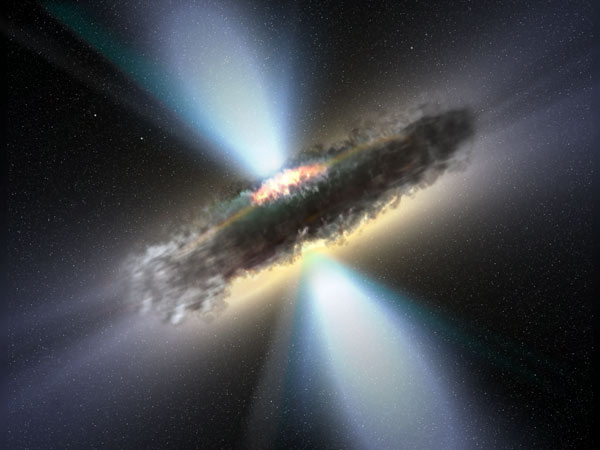
なぜブラックホールの周囲は、他のブラックホールよりも明るく見えるのでしょうか?活動銀河の中心には、太陽の質量の少なくとも数千倍の超大質量ブラックホールが存在します。セイファートI型と呼ばれる多くのブラックホールは、可視光で非常に明るく輝いています。一方、セイファートII型と呼ばれるブラックホールは、かなり暗く見えます。この違いは、ブラックホールによって物質の集積量がはるかに異なることが原因かもしれません。あるいは、セイファートII型銀河の中心にあるブラックホールは、周囲のトーラスによって隠されているのかもしれません。これらの相反する仮説のどちらが正しいかを判断するために、近傍のセイファートII型銀河NGC 4388は、最近、CGRO、SIGMA、BeppoSAX、INTEGRAL、Chandra、XMM-Newtonなど、多くの最新の地球周回X線観測衛星によってX線で観測されました。 INTEGRALとXMM-Newtonによる最近のデータによると、一部のX線色ではX線フラックスが急速に変化する一方、他のX線色ではフラックスが非常に安定していることが分かった。フラックスが一定であることと、特定のX線色が低温の鉄によって吸収されているように見えることから、NGC 4388の中心にあるブラックホールは、分子ガスと塵からなる厚いトーラスを通して観測されているという証拠が得られる。
原文(English)
Why do some black hole surroundings appear brighter than others? In the centers of active galaxies, supermassive black holes at least thousands of times the mass of our Sun dominate. Many, called Seyfert Type I, are very bright in visible light. Others, called Seyfert Type II, are rather dim. The difference might be caused by some black holes accreting much more matter than others. Alternatively, the black holes in the center of Seyfert Type II galaxies might be obscured by a surrounding torus. To help choose between these competing hypotheses, the nearby Seyfert II galaxy NGC 4388 has been observed in X-ray light recently by many recent Earth-orbiting X-ray observatories, including CGRO, SIGMA, BeppoSAX, INTEGRAL, Chandra, and XMM-Newton. Recent data from INTEGRAL and XMM-Newton have found that the X-ray flux in some X-ray colors varies rapidly, while flux in other X-ray colors is quite steady. The constant flux and apparent absorption of very specific X-ray colors by cool iron together give evidence that the central black hole in NGC 4388 is seen through a thick torus composed of molecular gas and dust.
\ この感動を宇宙仲間にシェア /
宇宙をXでシェア
© NASA / APOD