
🚀 宇宙の記憶・カレンダー検索
🚀 象徴的な写真:
APOD第1回
🚀 創造の柱
🚀 スピリット火星着陸
🚀 ハッブル超深宇宙
🚀 地球へようこそ|ブルー・マーブル
🚀 エンケラドス
🚀 ベテルギウス
🚀 火星着陸
🚀 青い夕焼け
🚀 冥王星のハート
🚀 皆既日食
🚀 アースライズ再構築
🚀 ブラックホール
🚀 ウェッブ初画像
🚀 アポロ11着陸
APOD30周年(2025年6月16日)
SSTが古い惑星の塵円盤を発見
Old Planetary Dust Disks Found by SST
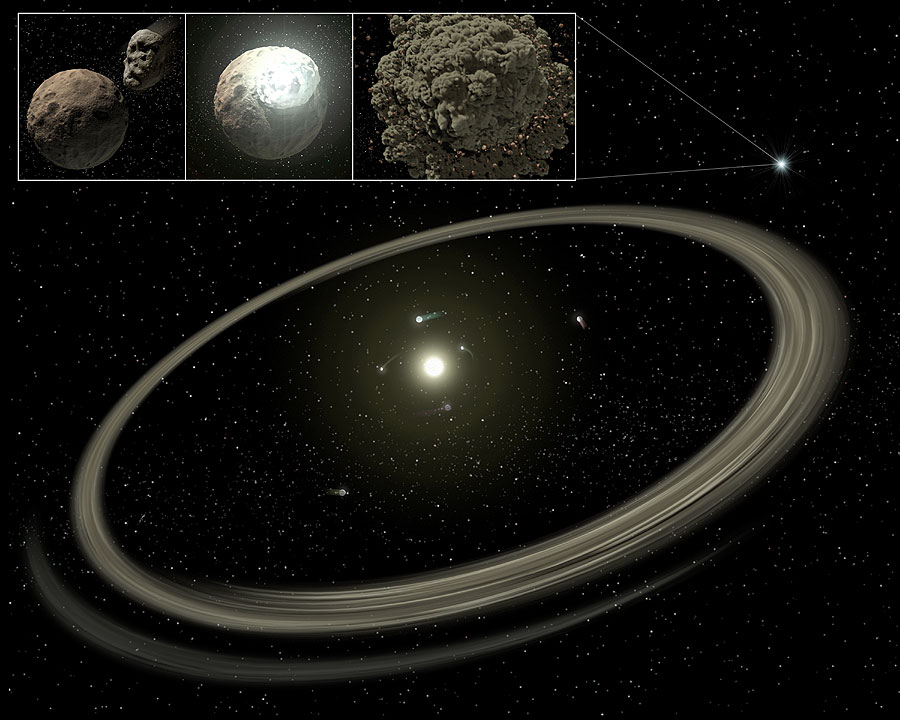
なぜ一部の古い星は塵に囲まれているのでしょうか?アリゾナ大学のジョージ・リーケ氏率いるチームによるスピッツァー宇宙望遠鏡の観測では、100万年程度の若い星は大きな塵の円盤を持ち、1000万年から1億年の比較的古い星は塵の円盤を持たないことが予想されていました。従来の考えでは、若い星の周りの塵の円盤はまだ惑星形成中であり、古い星系では惑星形成後にこれらの円盤は消散していると考えられていました。ところが、予想外にも、一部の古い星には印象的な塵の環や円盤の赤外線放射が見られました。考えられる説明としては、古い円盤は岩石惑星の形成中に発生した激しい衝突の残骸であるというものです。このようなシナリオから生じる塵の環は、上のイラストで示されています。
原文(English)
Why are some older stars surrounded by dust? Observations from the Spitzer Space Telescope by a team led by George Rieke (U. Arizona) were expected to show that young stars, on the order of one million years old, have large dust disks, while relatively older stars, between 10 and 100 million years old, have none. The conventional wisdom was that the dust disks surrounding young stars were still forming planets, while in older systems these disks had dissipated after planets had already formed. Unexpectedly, they found some older stars with the infrared glow of impressive rings or disks of dust. A possible explanation is that the old disks are remnant debris from violent collisions between many forming planets of rock. Resultant dust rings from such a scenario are depicted by an artist's illustration above.
\ この感動を宇宙仲間にシェア /
宇宙をXでシェア
© NASA / APOD