
🚀 宇宙の記憶・カレンダー検索
🚀 象徴的な写真:
APOD第1回
🚀 創造の柱
🚀 スピリット火星着陸
🚀 ハッブル超深宇宙
🚀 地球へようこそ|ブルー・マーブル
🚀 エンケラドス
🚀 ベテルギウス
🚀 火星着陸
🚀 青い夕焼け
🚀 冥王星のハート
🚀 皆既日食
🚀 アースライズ再構築
🚀 ブラックホール
🚀 ウェッブ初画像
🚀 アポロ11着陸
APOD30周年(2025年6月16日)
M74銀河内の超大型X線
ULXs in M74
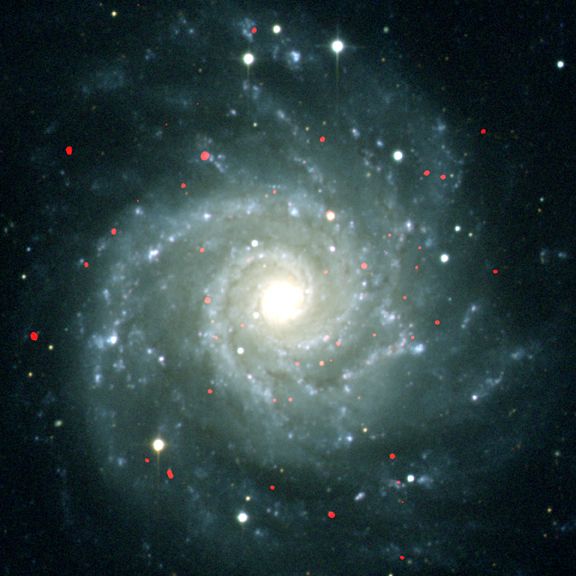
視覚的には、M74はうお座の方向に約3000万光年離れた、ほぼ完璧な正面向きの渦巻銀河です。この合成画像に見られる赤い斑点は、チャンドラX線観測衛星によってマッピングされた超高輝度X線源(ULX)です。ULXは、中性子星や恒星質量ブラックホールを宿す「普通の」X線連星よりも10~1000倍も多くのX線を実際に放射するため、このように呼ばれています。実際、これらのULXのX線輝度が2時間ほどの期間で変化するのを観測した結果、天文学者たちはULXが中間質量ブラックホールである可能性が高いと結論付けました。中間質量ブラックホールとは、太陽の1万倍ほどの質量を持つブラックホールですが、巨大な渦巻銀河の中心に潜む太陽質量の100万倍のブラックホールよりははるかに小さいものです。これらの中間質量ブラックホールはどのようにしてそこに存在するようになったのでしょうか?興味深い説の一つは、それらが渦巻銀河M74と合体しつつある、はるかに小さな銀河の中心部から残されたものだというものである。
原文(English)
In visual appearance, M74 is a nearly perfect face-on spiral galaxy, about 30 million light-years away toward the constellation Pisces. The red blotches seen in this composite view are ultraluminous x-ray sources (ULXs) mapped by the Chandra X-ray Observatory. The ULXs are so called because they actually do radiate 10 to 1,000 times more x-ray power than "ordinary" x-ray binary stars, which harbor a neutron star or stellar mass black hole. In fact, watching these ULXs change their x-ray brightness over periods of 2 hours or so, astronomers conclude that ULXs could well be intermediate mass black holes -- black holes with masses 10,000 times or so greater than the Sun, but still much less than the million solar mass black holes which lurk in the centers of large spiral galaxies. How did these intermediate mass black holes get there? One intriguing suggestion is that they are left over from the cores of much smaller galaxies that are merging with spiral galaxy M74.
\ この感動を宇宙仲間にシェア /
宇宙をXでシェア
© NASA / APOD