
🚀 宇宙の記憶・カレンダー検索
🚀 象徴的な写真:
APOD第1回
🚀 創造の柱
🚀 スピリット火星着陸
🚀 ハッブル超深宇宙
🚀 地球へようこそ|ブルー・マーブル
🚀 エンケラドス
🚀 ベテルギウス
🚀 火星着陸
🚀 青い夕焼け
🚀 冥王星のハート
🚀 皆既日食
🚀 アースライズ再構築
🚀 ブラックホール
🚀 ウェッブ初画像
🚀 アポロ11着陸
APOD30周年(2025年6月16日)
赤外線ヘリックス
Infrared Helix
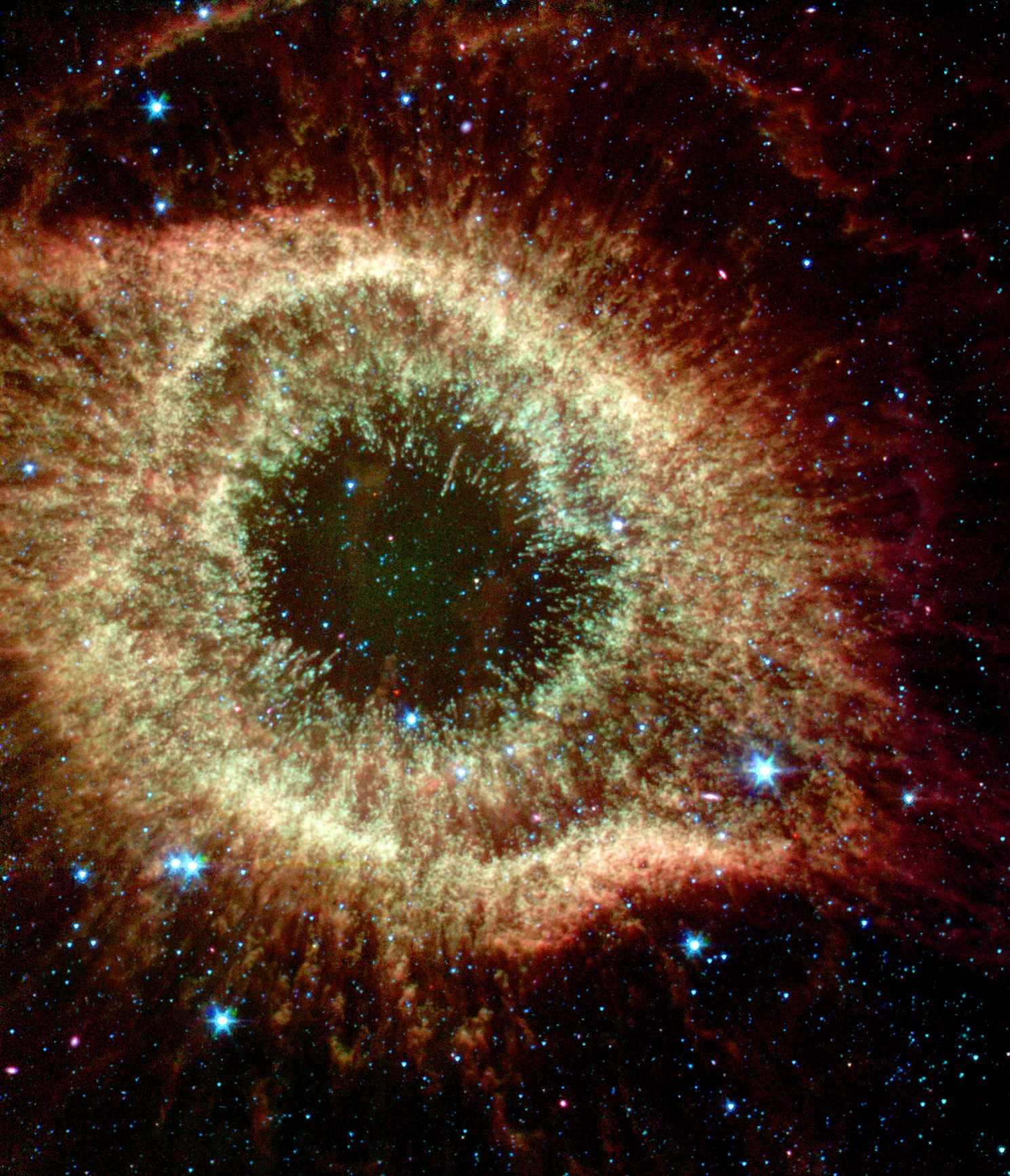
地球から600光年以上離れたみずがめ座の方向で、太陽のような恒星が死を迎えようとしています。その最後の数千年で形成されたのが、恒星進化の最終段階に典型的な惑星状星雲の、よく研究されている近距離の例であるヘリックス星雲(NGC 7293)です。スピッツァー宇宙望遠鏡が撮影したこの赤外線画像では、ヘリックスの放射は主に星雲の分子水素ガスから発せられています。ガスは塊状になっており、それぞれが太陽系の約2倍の大きさの彗星状の結び目を何千個も形成しています。より青く、よりエネルギーの高い放射は頭部から、より赤い放射は尾部から発せられているのが観測され、尾部は中心星の恒星風や強い紫外線からより遮蔽されていることを示唆しています。星雲自体の直径は約2.5光年です。太陽も、あと50億年後には惑星状星雲の段階を経ると予想されています。
原文(English)
Over six hundred light years from Earth, in the constellation Aquarius, a sun-like star is dying. Its last few thousand years have produced the Helix Nebula (NGC 7293), a well studied and nearby example of a Planetary Nebula, typical of this final phase of stellar evolution. Emission in this infrared Spitzer Space Telescope image of the Helix comes mostly from the nebula's molecular hydrogen gas. The gas appears to be clumpy, forming thousands of comet-shaped knots each spanning about twice the size of our solar system. Bluer, more energetic radiation is seen to come from the heads with redder emission from the tails, suggesting that they are more shielded from the central star's winds and intense ultraviolet radiation. The nebula itself is about 2.5 light-years across. The Sun is expected to go through its own Planetary Nebula phase ... in another 5 billion years.
\ この感動を宇宙仲間にシェア /
宇宙をXでシェア
© NASA / APOD