
🚀 宇宙の記憶・カレンダー検索
🚀 象徴的な写真:
APOD第1回
🚀 創造の柱
🚀 スピリット火星着陸
🚀 ハッブル超深宇宙
🚀 地球へようこそ|ブルー・マーブル
🚀 エンケラドス
🚀 ベテルギウス
🚀 火星着陸
🚀 青い夕焼け
🚀 冥王星のハート
🚀 皆既日食
🚀 アースライズ再構築
🚀 ブラックホール
🚀 ウェッブ初画像
🚀 アポロ11着陸
APOD30周年(2025年6月16日)
二つの半球の尾
A Tail of Two Hemispheres
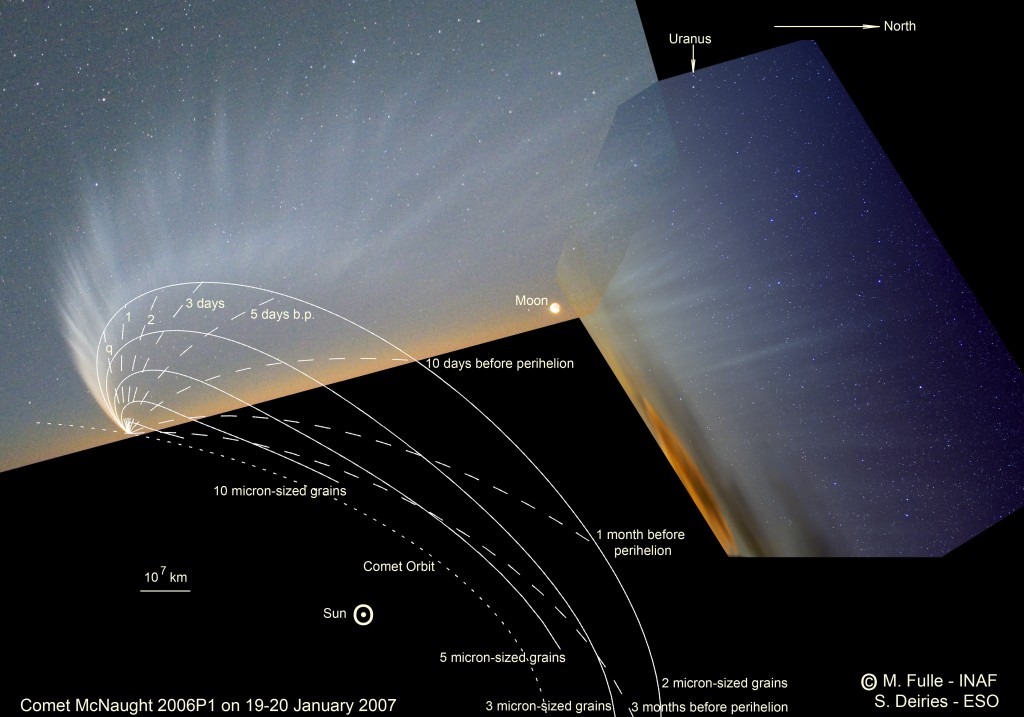
1月19日/20日までに、マクノート彗星の壮大な塵の尾は約1億5000万キロメートル(約1天文単位)にまで伸び、その全貌を捉えるには地球の南半球と北半球の両方からの画像が必要でした。チリのセロ・パラナル(左)とイタリアのカルニク・アルプスからの2つの画像が、このユニークな図に合成されており、彗星の軌道(点線)と太陽の相対的な位置も示されています。太陽放射圧によって、塵の尾は最初は太陽から遠ざかる方向を向いていますが、彗星の軌道の外側にも伸びています。天文学者は、塵に作用する力(重力、太陽風、放射など)と塵の放出時間とサイズを考慮することで、尾に沿った複雑な構造、特に顕著な縞模様を説明しようとしています。図では、近日点通過に対してほぼ同時に放出された塵の粒子の位置(同期)を破線で示しています。大きさがほぼ同じ粒子、すなわちシンダインの位置は実線で示されている。
原文(English)
By January 19/20 Comet McNaught's magnificent dust tail stretched for about 150 million kilometers (~1 AU), requiring images from both southern and northern hemispheres of planet Earth to take it all in. Two such views - from Cerro Paranal in Chile (left) and the Carnic Alps in Italy - are combined in this unique graphic that also outlines a perspective view of the comet's orbit (dotted line) and relative position of the Sun. Driven by solar radiation pressure the dust tail initially points away from the Sun, but also trails outside the comet's orbit. Astronomers try to account for the complex structure along the tail, including the pronounced striations, by considering forces acting on the dust (e.g. gravity, solar wind and radiation) as well as the release time and size of the dust grains. In the diagram, the modeled location of dust grains released at approximately the same time relative to perihelion passage, synchrones, are shown as dashed lines. The location of grains of similar size, syndynes, are shown as solid lines.
\ この感動を宇宙仲間にシェア /
宇宙をXでシェア
© S. Deiries
(ESO),
M. Fulle (INAF) / APOD