
🚀 宇宙の記憶・カレンダー検索
🚀 象徴的な写真:
APOD第1回
🚀 創造の柱
🚀 スピリット火星着陸
🚀 ハッブル超深宇宙
🚀 地球へようこそ|ブルー・マーブル
🚀 エンケラドス
🚀 ベテルギウス
🚀 火星着陸
🚀 青い夕焼け
🚀 冥王星のハート
🚀 皆既日食
🚀 アースライズ再構築
🚀 ブラックホール
🚀 ウェッブ初画像
🚀 アポロ11着陸
APOD30周年(2025年6月16日)
可視光で見たベラ超新星残骸
Vela Supernova Remnant in Visible Light
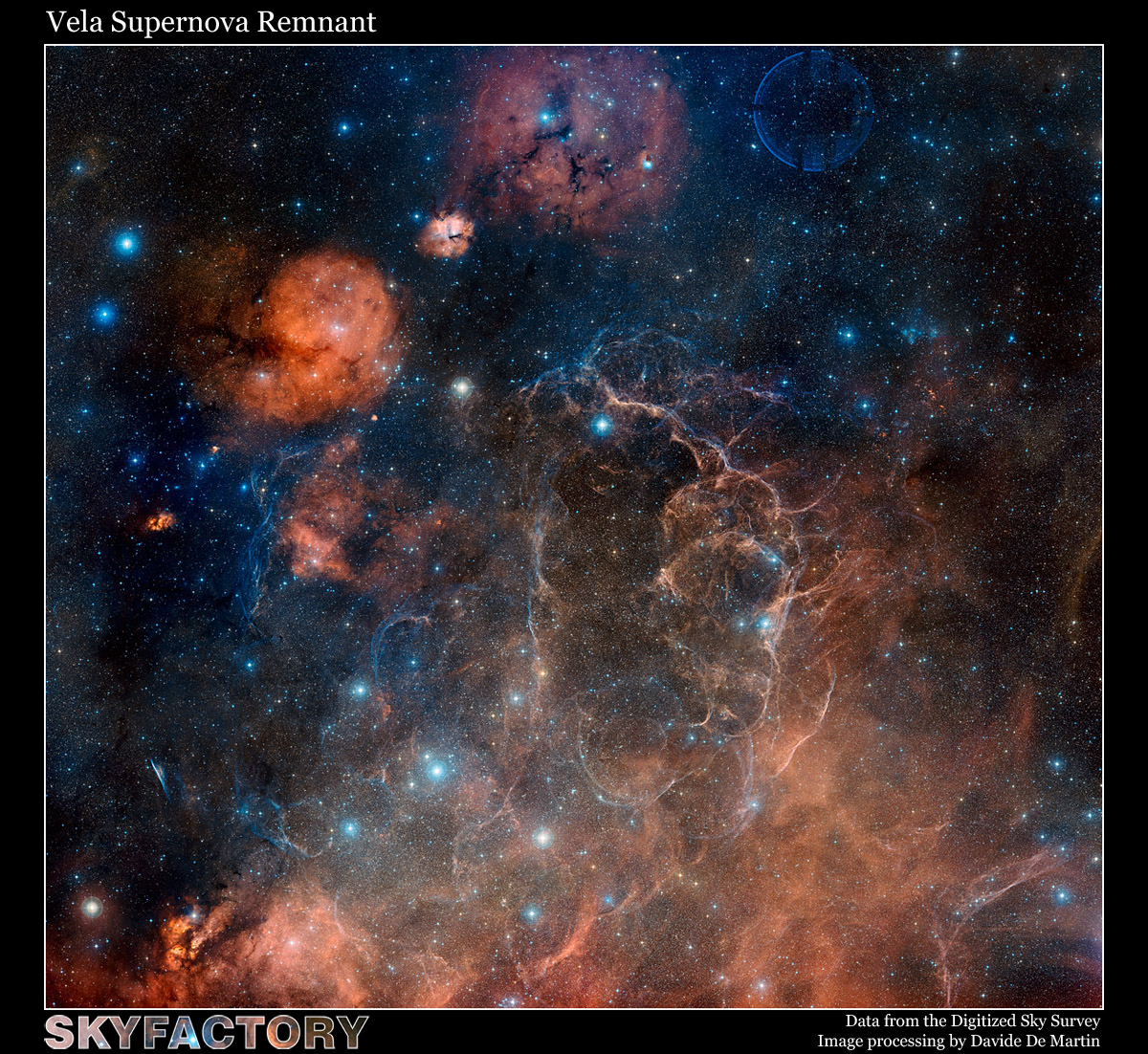
爆発は終わったが、その影響は続いている。約1万1千年前、ほ座の星が爆発し、記録された歴史の始まりの頃に生きていた人々には、奇妙な光点が短時間見えた。星の外層が星間物質に衝突し、今日でも見える衝撃波を発生させた。ほぼ球形で膨張する衝撃波はX線で見ることができる。上の画像は、そのフィラメント状の巨大な衝撃波の大部分を可視光で捉えたもので、ほぼ100光年に及び、満月の直径の20倍にも見える。爆発した星からガスが飛び散ると、崩壊して星間物質と反応し、さまざまな色とエネルギー帯の光を発する。ほ座超新星残骸の中心にはパルサーが残っている。パルサーは核物質と同じくらい密度の高い星で、1秒間に10回以上も完全に回転する。
原文(English)
The explosion is over but the consequences continue. About eleven thousand years ago a star in the constellation of Vela could be seen to explode, creating a strange point of light briefly visible to humans living near the beginning of recorded history. The outer layers of the star crashed into the interstellar medium, driving a shock wave that is still visible today. A roughly spherical, expanding shock wave is visible in X-rays. The above image captures much of that filamentary and gigantic shock in visible light, spanning almost 100 light years and appearing twenty times the diameter of the full moon. As gas flies away from the detonated star, it decays and reacts with the interstellar medium, producing light in many different colors and energy bands. Remaining at the center of the Vela Supernova Remnant is a pulsar, a star as dense as nuclear matter that completely rotates more than ten times in a single second.
\ この感動を宇宙仲間にシェア /
宇宙をXでシェア
© NASA / APOD