
🚀 宇宙の記憶・カレンダー検索
🚀 象徴的な写真:
APOD第1回
🚀 創造の柱
🚀 スピリット火星着陸
🚀 ハッブル超深宇宙
🚀 地球へようこそ|ブルー・マーブル
🚀 エンケラドス
🚀 ベテルギウス
🚀 火星着陸
🚀 青い夕焼け
🚀 冥王星のハート
🚀 皆既日食
🚀 アースライズ再構築
🚀 ブラックホール
🚀 ウェッブ初画像
🚀 アポロ11着陸
APOD30周年(2025年6月16日)
高次元宇宙?
A Higher Dimensional Universe?
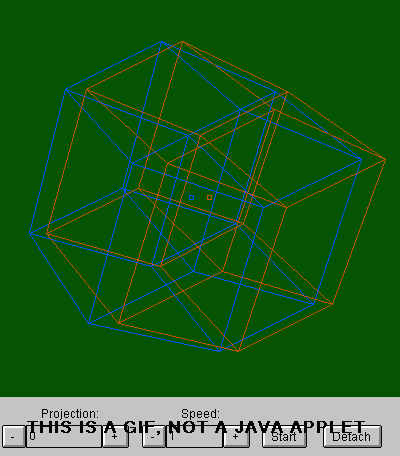
私たちの宇宙には、より高次元で特異な空間次元が存在するのでしょうか? この考えは、宇宙の遠く離れた部分がなぜこれほど似ているのか、また、宇宙の幾何学が、宇宙に含まれると思われる物質の量から自然に生じるものではないように見える理由を説明するのに役立つとして、人気を集めています。 この考えは、M理論(以前は弦理論と呼ばれていました)やランドール・サンドラム理論など、重力と量子力学を組み合わせようとする現代の試みでも広く用いられています。 このようなモデルは、ブレーンやバルクを含み、量子エネルギーの一部や測定された宇宙定数がなぜこれほど小さいのかなど、さまざまなことを説明しようと試みています。 上図は、5次元立方体(4次元の空間次元を持つ超立方体はテセラクトとも呼ばれます)の4次元描写の動的な3次元図(2次元の空間次元と1次元の時間次元)を示しています。 赤と青のメガネをかけると、多次元的な視点が最もよく得られます。 ニュース:明日、部分日食が起こります。
原文(English)
Does our universe have higher but unusual spatial dimensions? This idea has been gaining popularity to help explain why vastly separated parts of our universe appear so similar, and why the geometry of our universe does not seem to result naturally from the amounts of matter it seems to contain. The idea is also prevalent in modern attempts to combine gravity and quantum mechanics that include M-theory (formerly string theory) and Randall-Sundrum theory. Such models involve branes and bulks and frequently attempt to explain, among other things, why some quantum energies and the measured cosmological constant are so small. Above, a dynamic three-dimensional drawing (two spatial plus one time) of a four-dimensional depiction of a five-dimensional cube (a hypercube with four spatial dimensions is also known as a tesseract) is shown. Donning red-blue glasses will give the best multi-dimensional perspective. News: A partial solar eclipse will occur tomorrow.
\ この感動を宇宙仲間にシェア /
宇宙をXでシェア
© Mark Newbold / APOD