
🚀 宇宙の記憶・カレンダー検索
🚀 象徴的な写真:
APOD第1回
🚀 創造の柱
🚀 スピリット火星着陸
🚀 ハッブル超深宇宙
🚀 地球へようこそ|ブルー・マーブル
🚀 エンケラドス
🚀 ベテルギウス
🚀 火星着陸
🚀 青い夕焼け
🚀 冥王星のハート
🚀 皆既日食
🚀 アースライズ再構築
🚀 ブラックホール
🚀 ウェッブ初画像
🚀 アポロ11着陸
APOD30周年(2025年6月16日)
グリーゼ581と居住可能領域
Gliese 581 and the Habitable Zone
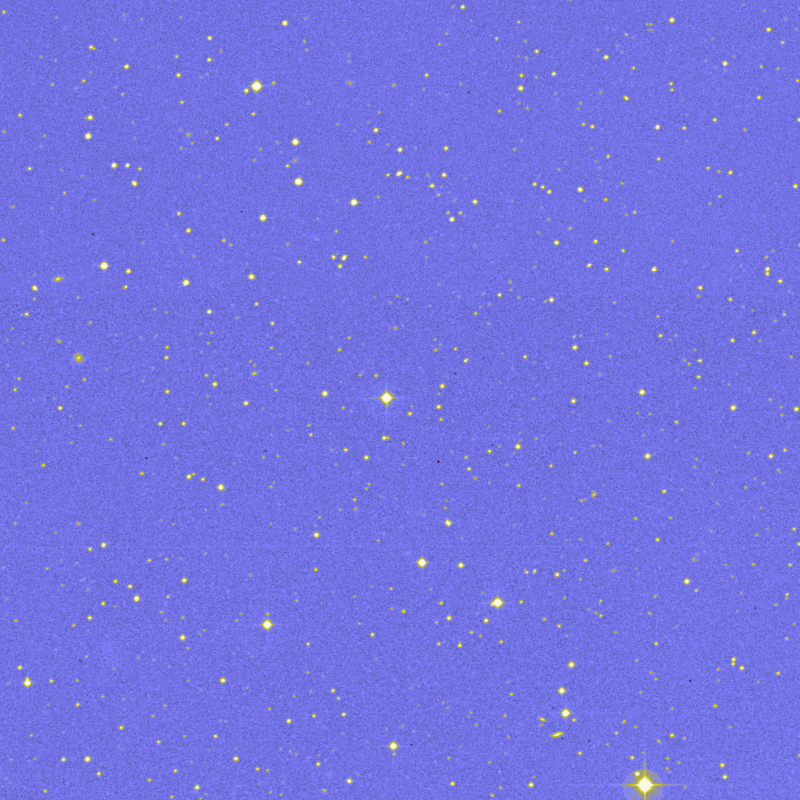
この空の写真の中央に写っている目立たない星は、天秤座の方向にわずか20光年離れたグリーゼ581です。しかし、天文学者たちは今、グリーゼ581を周回する3つの惑星からなる驚くべき惑星系を発見したと報告しています。その中には、太陽系外で発見された中で最も地球に似た惑星も含まれています。グリーゼ581自体は太陽のような星ではありません。赤色矮星に分類されるこの星は、太陽よりもはるかに小さく、温度も低いのです。それでも、この星を周回する既知の最小の惑星は、地球の5倍の質量を持ち、直径は約1.5倍と推定されています。このスーパーアースは13日ごとに1周し、地球と太陽の距離の約14分の1の距離で主星を周回しています。この低温の星の周りを周回する近距離軌道は、平均表面温度が0~40℃(水が液体となる温度範囲)であることを示唆しており、この惑星は赤色矮星のハビタブルゾーンに位置することになります。
原文(English)
The unremarkable star centered in this skyview is Gliese 581, a mere 20 light-years away toward the constellation Libra. But astronomers are now reporting the discovery of a remarkable system of three planets orbiting Gliese 581, including the most earth-like planet found beyond our solar system. Gliese 581 itself is not a sun-like star, though. Classified as a red dwarf, the star is much smaller and colder than the Sun. Still, the smallest planet known to orbit the star is estimated to be five times as massive as Earth with about 1.5 times Earth's diameter. That super-earth orbits once every 13 days, about 14 times closer to its parent star than the Earth-Sun distance. The close-in orbit around the cool star implies a mean surface temperature of between 0 and 40 degrees C - a range over which water would be liquid - and places the planet in the red dwarf's habitable zone.
\ この感動を宇宙仲間にシェア /
宇宙をXでシェア
© NASA / APOD