
🚀 宇宙の記憶・カレンダー検索
🚀 象徴的な写真:
APOD第1回
🚀 創造の柱
🚀 スピリット火星着陸
🚀 ハッブル超深宇宙
🚀 地球へようこそ|ブルー・マーブル
🚀 エンケラドス
🚀 ベテルギウス
🚀 火星着陸
🚀 青い夕焼け
🚀 冥王星のハート
🚀 皆既日食
🚀 アースライズ再構築
🚀 ブラックホール
🚀 ウェッブ初画像
🚀 アポロ11着陸
APOD30周年(2025年6月16日)
Galexが撮影した、紫外線で捉えた明るい渦巻銀河M81
Bright Spiral Galaxy M81 in Ultraviolet from Galex
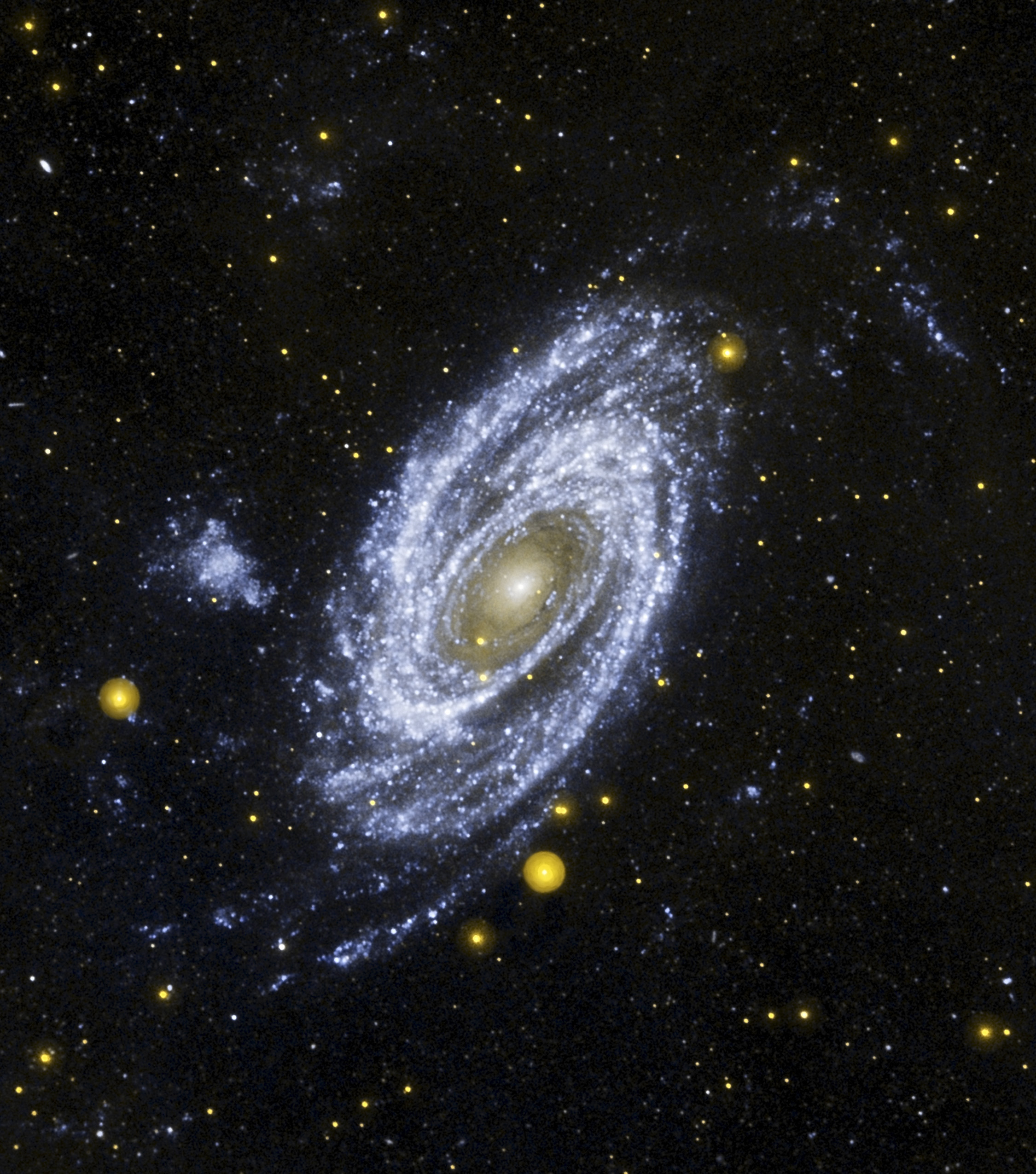
最も近い主要な渦巻銀河の 1 つですが、M81 の高温の星はどこにあるのでしょうか? それを解明するために、天文学者たちは地球周回軌道上の Galex 望遠鏡で、この広大な渦巻銀河の紫外線による深層画像を撮影しました。高温の星は低温の星よりも多くの紫外線を放出し、若い散開星団や活発な星形成領域と関連していることがよくあります。壮大な渦巻銀河 M81 は、私たちの天の川銀河よりわずかに小さいサイズで、上の画像では、渦巻腕に若い星々が見られます。1 億年未満の若い星々は、上の Galex の擬似カラー画像では青色で、銀河中心部の古い黄色の星々から十分に離れていることがわかります。M81 の上空には、ホルムバーグ IX と呼ばれる伴銀河が見えます。この小さな不規則銀河の予想外に明るい紫外線の輝きを研究することで、天文学者たちは、私たちの天の川銀河の多くの伴銀河がどのように発達したかを理解するのに役立つかもしれません。小型望遠鏡でも見えるM81は、約7万光年の大きさで、おおぐま座の方向に約1200万光年離れたところに位置しています。
原文(English)
Where are the hot stars in M81, one of the closest major spiral galaxies? To help find out, astronomers took a deep image in ultraviolet light of the sprawling spiral with the Earth-orbiting Galex telescope. Hot stars emit more ultraviolet than cool stars, and are frequently associated with young open clusters of stars and energetic star forming regions. Magnificent spiral galaxy M81, slightly smaller in size to our own Milky Way Galaxy, shows off its young stars in its winding spiral arms in the above image. Less than 100 million years old, the young stars are blue in the above false-color Galex image and seen to be well separated from the older yellowish stars of the galactic core. Visible above M81 is a satellite galaxy dubbed Holmberg IX. Studying the unexpectedly bright ultraviolet glow of this small irregular galaxy may help astronomers understand how the many satellites of our own Milky Way Galaxy developed. M81, visible through a small telescope, spans about 70,000 light years and lies about 12 million light years away toward the constellation of the Great Bear (Ursa Major).
\ この感動を宇宙仲間にシェア /
宇宙をXでシェア
© NASA / APOD