
🚀 宇宙の記憶・カレンダー検索
🚀 象徴的な写真:
APOD第1回
🚀 創造の柱
🚀 スピリット火星着陸
🚀 ハッブル超深宇宙
🚀 地球へようこそ|ブルー・マーブル
🚀 エンケラドス
🚀 ベテルギウス
🚀 火星着陸
🚀 青い夕焼け
🚀 冥王星のハート
🚀 皆既日食
🚀 アースライズ再構築
🚀 ブラックホール
🚀 ウェッブ初画像
🚀 アポロ11着陸
APOD30周年(2025年6月16日)
Arp 273
Arp 273
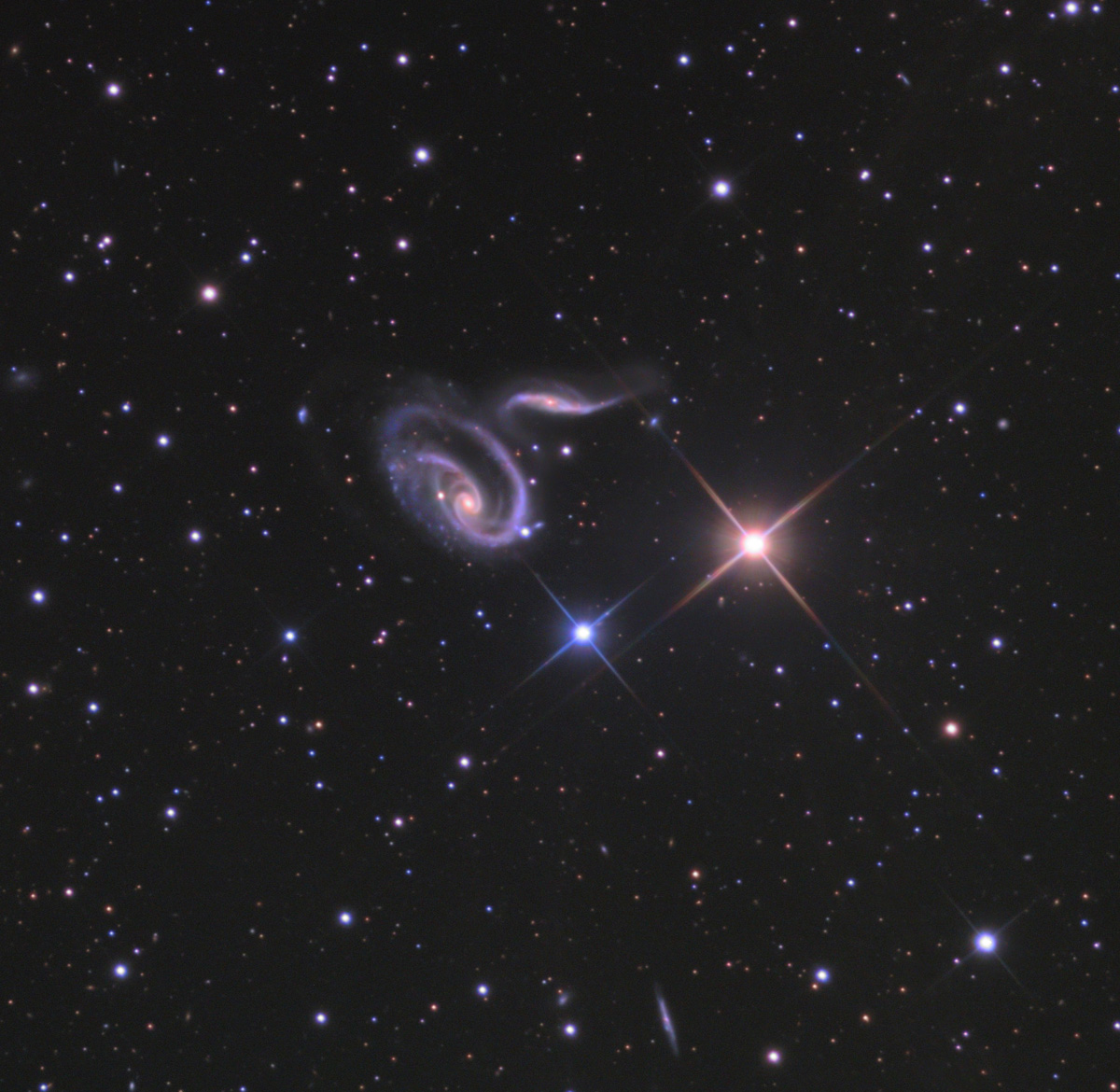
この色鮮やかな空の風景の手前に写っている2つの目立つ星は、私たちの銀河系である天の川銀河の中にあります。それらが尖って見えるのは、天文学者の望遠鏡による回折現象によるものです。しかし、目を引く2つの銀河は、天の川銀河のはるか彼方、約2億光年離れたところにあります。それらが歪んで見えるのは、2つの銀河が接近遭遇する際の重力潮汐によるものです。私たちの視点から見ると、銀河の明るい中心部は約8万光年離れています。Arp 273(UGC 1810とも呼ばれる)としてカタログ化されているこれらの銀河は、確かに奇妙な形をしていますが、相互作用する銀河は現在、宇宙ではごく普通に存在することが分かっています。実際、近くにある巨大な渦巻銀河アンドロメダ銀河は、約200万光年離れたところにあり、天の川銀河に接近していることが知られています。Arp 273は、遠い未来に起こるであろうアンドロメダ銀河の接近遭遇の類似例となるかもしれません。宇宙規模の時間スケールで繰り返される銀河の衝突は、最終的に一つの星の銀河へと合体する結果をもたらす可能性がある。
原文(English)
The two prominent stars in the foreground of this colorful skyscape are well within our own Milky Way Galaxy. Their spiky appearance is due to diffraction in the astronomer's telescope. But the two eye-catching galaxies in view lie far beyond the Milky Way, at a distance of about 200 million light-years. Their distorted appearance is due to gravitational tides as the pair engage in close encounters. From our perspective, the bright cores of the galaxies are separated by about 80,000 light-years. Cataloged as Arp 273 (also as UGC 1810), the galaxies do look peculiar, but interacting galaxies are now understood to be common in the universe. In fact, the nearby large spiral Andromeda Galaxy is known to be some 2 million light-years away and approaching the Milky Way. Arp 273 may offer an analog of their far future encounter. Repeated galaxy encounters on a cosmic timescale can ultimately result in a merger into a single galaxy of stars.
\ この感動を宇宙仲間にシェア /
宇宙をXでシェア
© Adam Block / APOD