
🚀 宇宙の記憶・カレンダー検索
🚀 象徴的な写真:
APOD第1回
🚀 創造の柱
🚀 スピリット火星着陸
🚀 ハッブル超深宇宙
🚀 地球へようこそ|ブルー・マーブル
🚀 エンケラドス
🚀 ベテルギウス
🚀 火星着陸
🚀 青い夕焼け
🚀 冥王星のハート
🚀 皆既日食
🚀 アースライズ再構築
🚀 ブラックホール
🚀 ウェッブ初画像
🚀 アポロ11着陸
APOD30周年(2025年6月16日)
ルリン彗星の二つの尾
Two Tails of Comet Lulin
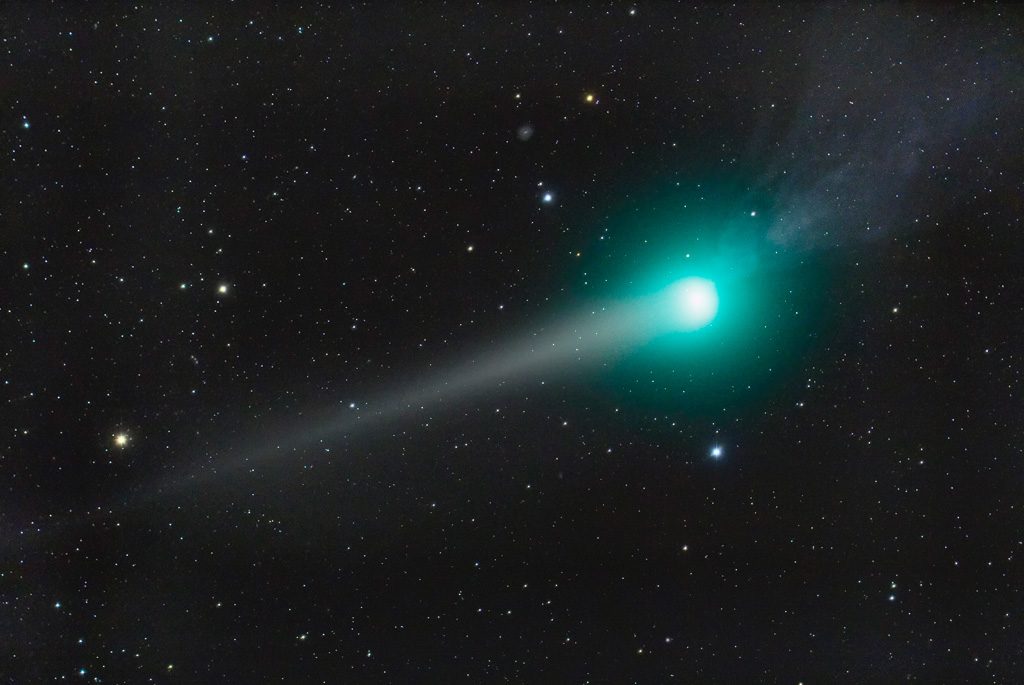
今夜外に出て、ルリン彗星を見てください。暗い場所であれば、良い星図と素晴らしい忍耐力さえあれば十分でしょう。ただし、広視野双眼鏡があると便利かもしれません。昨日、ルリン彗星は地球に最も接近したため、今後数日間は最も明るい状態が続くでしょう。彗星は現在、太陽からほぼ180度離れた位置にあるため、ほぼ一晩中見ることができますが、空では満月10個分ほど移動しているように見えます。この画像は、2日前、アメリカ合衆国ニューメキシコ州でルリン彗星が壮観な姿で撮影されたものです。彗星の中心にあるコマはかなり緑色に見え、これはおそらく輝く分子炭素ガスを示していると思われます。画像の背景には、明るい星と遠くの渦巻銀河がはっきりと見えます。太陽光を反射する黄色の塵の尾は、彗星のコマの左側に広がり、彗星の後ろに尾を引いているのが見える。一方、青みがかった光を放つ質感のあるイオンの尾は、コマの右側に見え、太陽とは反対方向を向いている。ここ数週間、地球の現在の位置からは、これら2つの尾は反対方向を向いているように見えた。ルリン彗星は今後数週間かけて徐々に暗くなっていくと予想されている。
原文(English)
Go outside tonight and see Comet Lulin. From a dark location, you should need only a good star map and admirable perseverance -- although wide-field binoculars might help. Yesterday, Comet Lulin passed its closest to Earth, so that the comet will remain near its brightest over the next few days. The comet is currently almost 180 degrees around from the Sun and so visible nearly all night long, but will appear to move on the sky about 10 full moons a night. In this image, Comet Lulin was captured in spectacular form two nights ago from New Mexico, USA. The central coma of the comet is appearing quite green, a color likely indicating glowing molecular carbon gasses. Bright stars and a distant spiral galaxy are clearly visible in the image background. The yellow dust tail, reflecting sunlight, is visible sprawling to the coma's left trailing behind the comet, while the textured bluish-glowing ion tail is visible to the coma's right, pointing away from the Sun. Over the past few weeks, from the current vantage point of Earth, these two tails appeared to point in opposite directions. Comet Lulin is expected to slowly fade over the next few weeks.
\ この感動を宇宙仲間にシェア /
宇宙をXでシェア
© Richard Richins
(NMSU) / APOD