
🚀 宇宙の記憶・カレンダー検索
🚀 象徴的な写真:
APOD第1回
🚀 創造の柱
🚀 スピリット火星着陸
🚀 ハッブル超深宇宙
🚀 地球へようこそ|ブルー・マーブル
🚀 エンケラドス
🚀 ベテルギウス
🚀 火星着陸
🚀 青い夕焼け
🚀 冥王星のハート
🚀 皆既日食
🚀 アースライズ再構築
🚀 ブラックホール
🚀 ウェッブ初画像
🚀 アポロ11着陸
APOD30周年(2025年6月16日)
ティコの超新星残骸
Tycho's Supernova Remnant
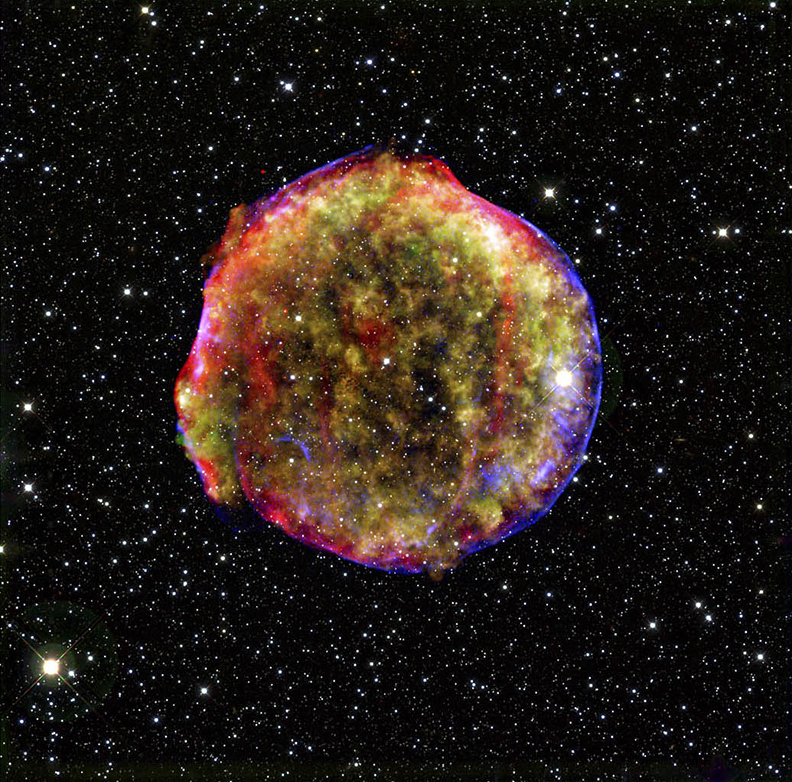
この巨大な綿毛状の塊はどの星が作ったのでしょうか? 上の画像は、有名な天文学者ティコ・ブラーエが400年以上前に初めて記録した恒星爆発の結果であるティコの超新星残骸の、これまでで最も優れた多波長画像です。上の画像は、軌道上のチャンドラX線観測衛星が撮影したX線画像、軌道上のスピッツァー宇宙望遠鏡が撮影した赤外線画像、およびスペイン南部にある3.5メートルのカラール・アルト望遠鏡が撮影した光学画像を合成したものです。膨張するガス雲は非常に高温ですが、わずかに異なる膨張速度により、雲はふっくらとした外観になっています。SN 1572 を生成した星はおそらく完全に消滅していますが、ここでは容易に識別できないほど暗いティコGと呼ばれる星が、伴星の可能性として研究されています。ティコの超新星の起源となる残骸を見つけることは、この超新星が最近Ia型であることが判明したため、特に重要です。 Ia型超新星の最大輝度はよく理解されていると考えられており、宇宙が遠方の天体をどのように減光させるかを較正する上で非常に貴重な存在となっている。
原文(English)
What star created this huge puffball? Pictured above is the best multi-wavelength image yet of Tycho's supernova remnant, the result of a stellar explosion first recorded over 400 years ago by the famous astronomer Tycho Brahe. The above image is a composite of an X-ray image taken by the orbiting Chandra X-ray Observatory, an infrared image taken by the orbiting Spitzer Space Telescope, and an optical image taken by the 3.5-meter Calar Alto telescope located in southern Spain. The expanding gas cloud is extremely hot, while slightly different expansion speeds have given the cloud a puffy appearance. Although the star that created SN 1572, is likely completely gone, a star dubbed Tycho G, too dim to be easily discerned here, is being studied as the possible companion. Finding progenitor remnants of Tycho's supernova is particularly important because the supernova was recently determined to be of Type Ia. The peak brightness of Type Ia supernovas is thought to be well understood, making them quite valuable in calibrating how our universe dims distant objects.
\ この感動を宇宙仲間にシェア /
宇宙をXでシェア
© NASA / APOD