
🚀 宇宙の記憶・カレンダー検索
🚀 象徴的な写真:
APOD第1回
🚀 創造の柱
🚀 スピリット火星着陸
🚀 ハッブル超深宇宙
🚀 地球へようこそ|ブルー・マーブル
🚀 エンケラドス
🚀 ベテルギウス
🚀 火星着陸
🚀 青い夕焼け
🚀 冥王星のハート
🚀 皆既日食
🚀 アースライズ再構築
🚀 ブラックホール
🚀 ウェッブ初画像
🚀 アポロ11着陸
APOD30周年(2025年6月16日)
ペルセウス座銀河団の銀河
Galaxies of the Perseus Cluster
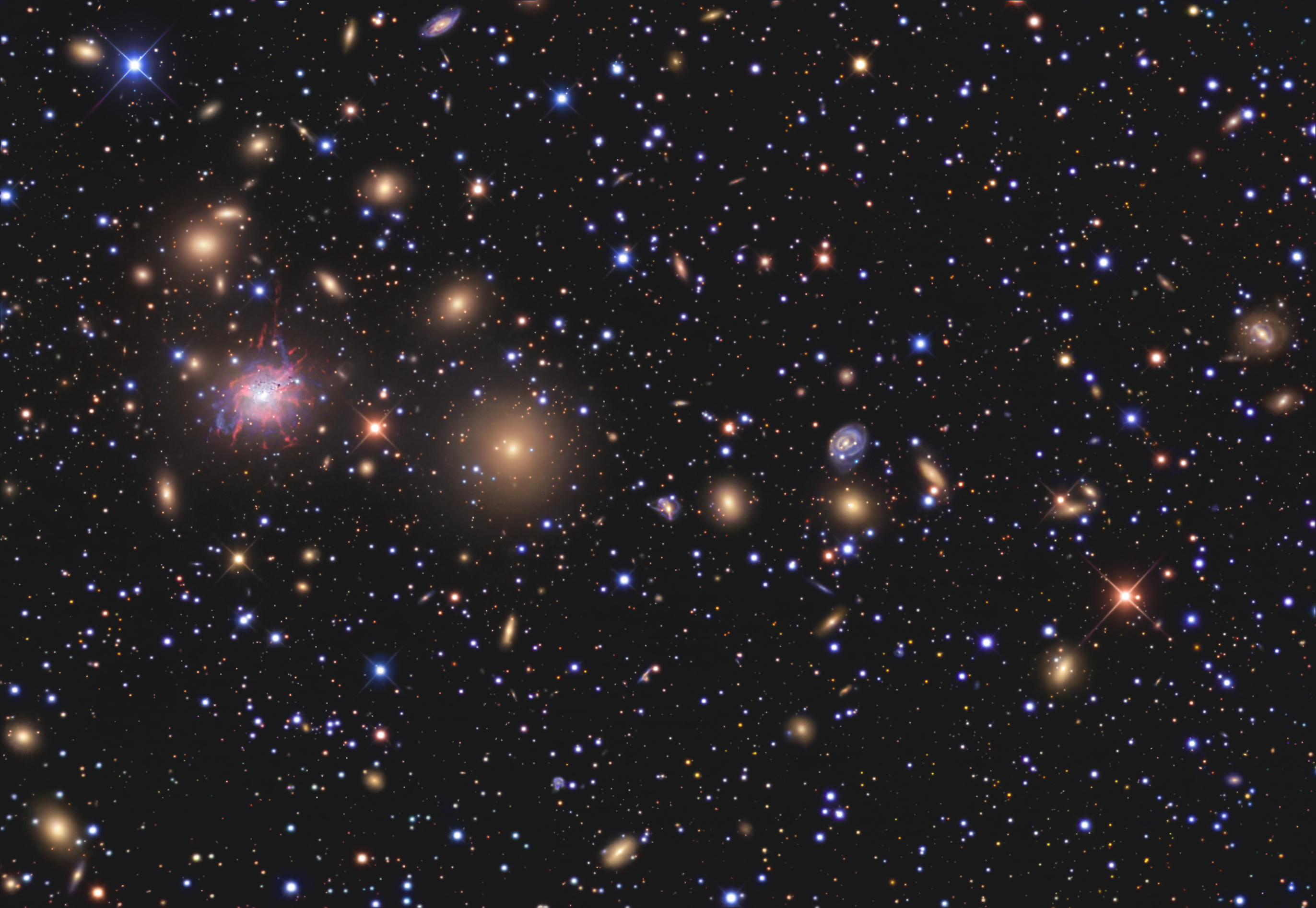
この色鮮やかな望遠鏡で捉えた空には、約2億5千万光年離れたペルセウス座銀河団の銀河が数多く存在します。私たちの天の川銀河の手前の星々のベールの向こうには、それらの広がり、時には驚くべき形状が見られます。最終的に1000個以上の銀河からなるこの銀河団は、この銀河団の中心領域の画像に散在するような、黄色がかった楕円銀河やレンズ状銀河で満たされています。特に左側の大きな銀河は、巨大で奇妙な形をしたNGC 1275です。高エネルギー放射の驚異的な源である活動銀河NGC 1275は、ペルセウス座銀河団を支配し、銀河全体が落下して銀河の中心にある超大質量ブラックホールに物質を供給しています。もちろん、ペルセウス座銀河団には渦巻銀河も存在し、写真中央右寄りの小さな正面向き渦巻銀河NGC 1268もその一つです。NGC 1268の外縁にある青みがかった斑点は超新星SN 2008fgです。ペルセウス座銀河団の推定距離に基づくと、この領域は約150万光年に及びます。
原文(English)
This colorful telescopic skyscape is filled with galaxies that lie nearly 250 million light-years away, the galaxies of the Perseus cluster. Their extended and sometimes surprising shapes are seen beyond a veil of foreground stars in our own Milky Way. Ultimately consisting of over a thousand galaxies, the cluster is filled with yellowish elliptical and lenticular galaxies, like those scattered throughout this view of the cluster's central region. Notably, the large galaxy at the left is the massive and bizarre-looking NGC 1275. A prodigious source of high-energy emission, active galaxy NGC 1275 dominates the Perseus cluster, accreting matter as entire galaxies fall into it and feed the supermassive black hole at the galaxy's core. Of course, spiral galaxies also inhabit the Perseus cluster, including the small, face-on spiral NGC 1268, right of picture center. The bluish spot on the outskirts of NGC 1268 is supernova SN 2008fg. At the estimated distance of the Perseus galaxy cluster, this field spans about 1.5 million light-years.
\ この感動を宇宙仲間にシェア /
宇宙をXでシェア
© R. Jay Gabany / APOD