
🚀 宇宙の記憶・カレンダー検索
🚀 象徴的な写真:
APOD第1回
🚀 創造の柱
🚀 スピリット火星着陸
🚀 ハッブル超深宇宙
🚀 地球へようこそ|ブルー・マーブル
🚀 エンケラドス
🚀 ベテルギウス
🚀 火星着陸
🚀 青い夕焼け
🚀 冥王星のハート
🚀 皆既日食
🚀 アースライズ再構築
🚀 ブラックホール
🚀 ウェッブ初画像
🚀 アポロ11着陸
APOD30周年(2025年6月16日)
メシエ106
Messier 106
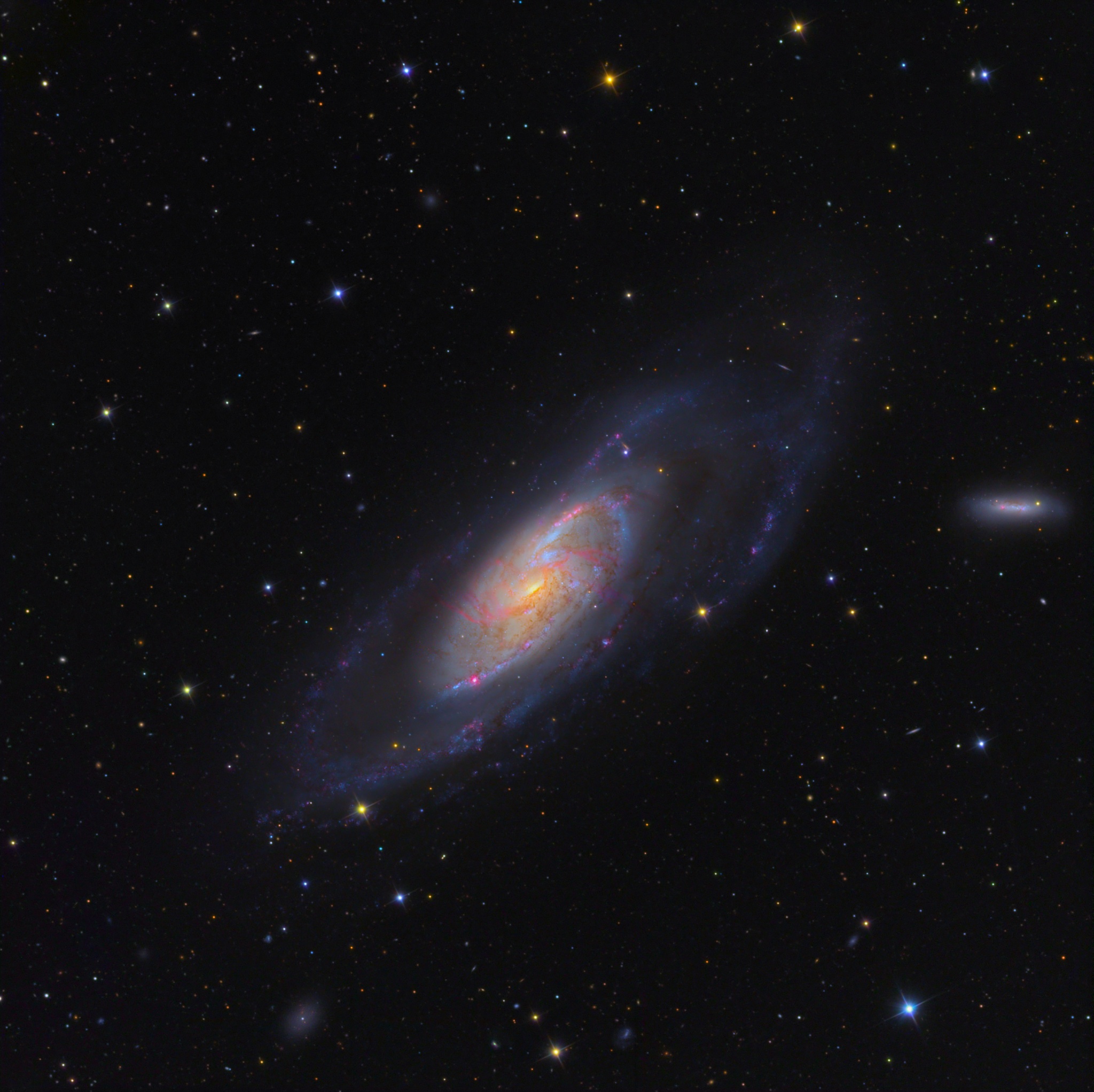
おおぐま座(Ursa Major)の近くに位置し、りょうけん座(Canes Venatici)の星々に囲まれたこの天体は、1781年にフランスの天文学者ピエール・メシャンによって発見されました。後に、彼の友人であり同僚でもあるシャルル・メシエのカタログにM106として追加されました。現代の望遠鏡による深宇宙観測では、この銀河は島銀河であることが明らかになっています。直径約3万光年の渦巻銀河で、天の川銀河の星々からわずか約2100万光年離れたところに位置しています。明るい中心核に加え、この色鮮やかな合成画像では、銀河の渦状腕に沿って若い青い星団と赤みがかった星形成領域が強調されています。また、赤みがかった輝く水素ガスのジェットもはっきりと写っています。画像の右端付近にある小さな伴銀河NGC 4248の他に、背景の銀河が画面全体に散らばっているのが見られます。 M106(別名NGC 4258)は、電波からX線まで幅広い波長域で観測されるセイファート型活動銀河の近辺の例である。活動銀河は、中心にある巨大なブラックホールに物質が落下することでエネルギーを得ていると考えられている。
原文(English)
Close to the Great Bear (Ursa Major) and surrounded by the stars of the Hunting Dogs (Canes Venatici), this celestial wonder was discovered in 1781 by the metric French astronomer Pierre Mechain. Later, it was added to the catalog of his friend and colleague Charles Messier as M106. Modern deep telescopic views reveal it to be an island universe -- a spiral galaxy around 30 thousand light-years across located only about 21 million light-years beyond the stars of the Milky Way. Along with a bright central core, this colorful composite image highlights youthful blue star clusters and reddish stellar nurseries tracing the galaxy's spiral arms. It also shows remarkable reddish jets of glowing hydrogen gas. In addition to small companion galaxy NGC 4248 near the picture's right edge, background galaxies can be found scattered throughout the frame. M106 (aka NGC 4258) is a nearby example of the Seyfert class of active galaxies, seen across the spectrum from radio to x-rays. Active galaxies are believed to be powered by matter falling into a massive central black hole.
\ この感動を宇宙仲間にシェア /
宇宙をXでシェア
© Ken Crawford / APOD