
🚀 宇宙の記憶・カレンダー検索
🚀 象徴的な写真:
APOD第1回
🚀 創造の柱
🚀 スピリット火星着陸
🚀 ハッブル超深宇宙
🚀 地球へようこそ|ブルー・マーブル
🚀 エンケラドス
🚀 ベテルギウス
🚀 火星着陸
🚀 青い夕焼け
🚀 冥王星のハート
🚀 皆既日食
🚀 アースライズ再構築
🚀 ブラックホール
🚀 ウェッブ初画像
🚀 アポロ11着陸
APOD30周年(2025年6月16日)
VB 10:小さな恒星を周回する大きな惑星
VB 10: A Large Planet Orbiting a Small Star
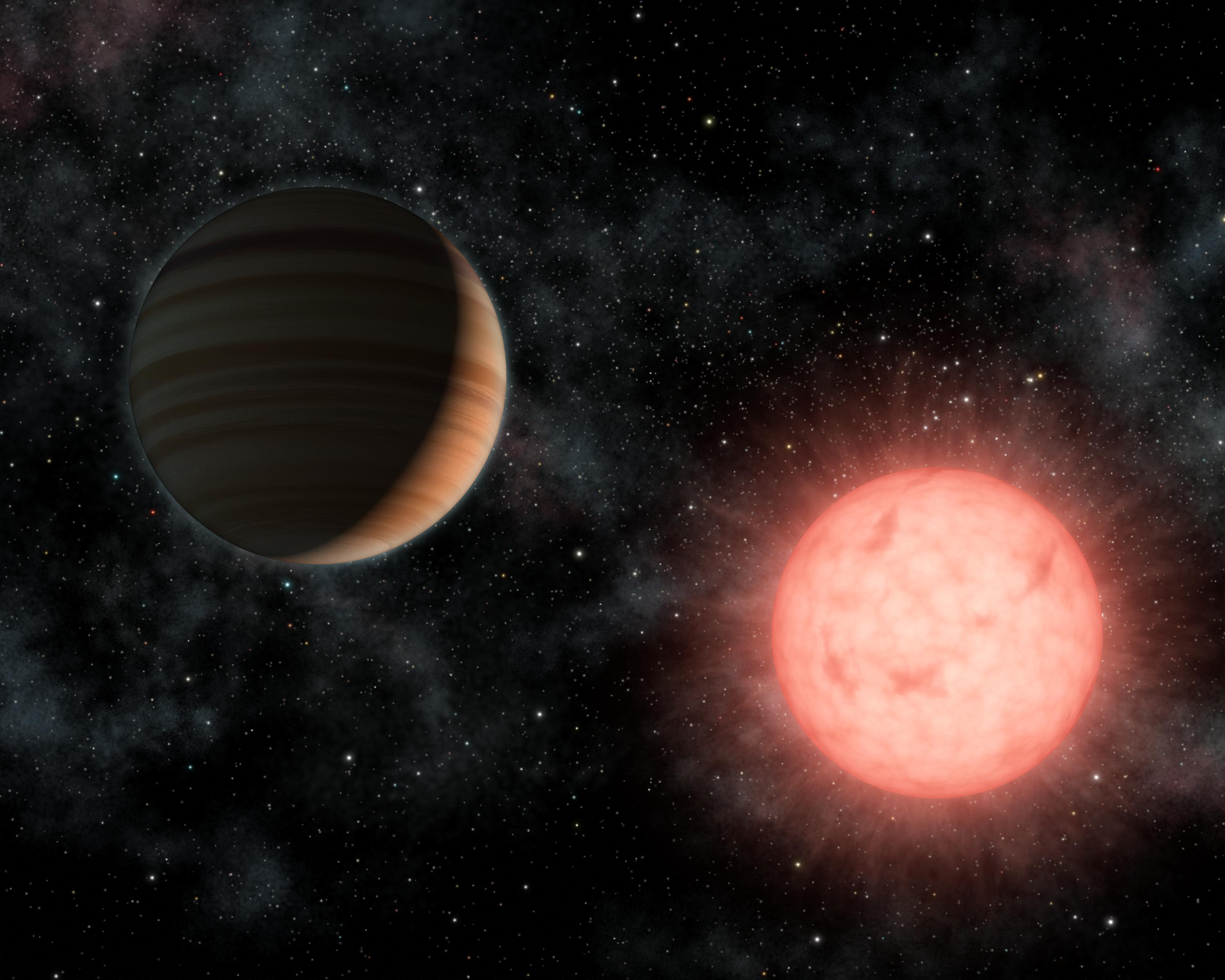
惑星は、その周回する恒星と同じくらいの大きさになり得るのだろうか?最近の観測で、近隣のヴァン・ビースブルック星に、まさにそのような巨大な惑星が存在する可能性が発見された。VB 10はわずか20光年ほどしか離れていないが、17等級という非常に暗い赤色矮星であるため、観測するには望遠鏡が必要となる。ヴァン・ビースブルック星は、これまで空を横切る固有運動が非常に速いことで知られており、満月を横切るのに約1000年しかかからないほどの速さで移動していた。天文学者たちは、VB 10の軌道のわずかなずれに着目し、木星の数倍の質量を持つ惑星の存在を推測した。恒星VB 10は、発見された惑星VB 10bよりもおそらく10倍ほどの質量を持つが、恒星の方が圧縮されているため、両者の大きさはほぼ同じである可能性がある。このような系を、上のイラストで想像した。 VB 10のような暗いM型星は非常に一般的であるため、それらの周囲には、主星よりも大きな惑星を含む惑星系が、私たちの太陽系のような惑星系よりも多く存在する可能性があります。無料講演:APODの編集者が、今週金曜日にミシガン州カラマズーで素晴らしい宇宙画像を解説します。
原文(English)
Can a planet be as large as the star that it orbits? Recent observations have discovered that nearby Van Biesbroeck's star might have just such a large planet. Although VB 10 lies only about 20 light years away, it is a small red dwarf star so dim, at 17th magnitude, that a telescope is needed to see it. Van Biesbroeck's star was previously known for its rapid proper motion across the sky -- it moves so fast it could cross a full moon in only about 1,000 years. By noting a wiggle in VB 10's sky trajectory, astronomers were able to infer the existence of a planet several times the mass of Jupiter. Although the star VB 10 is perhaps 10 times more massive than the discovered planet VB 10b, the star is likely more highly compressed and so the two might be closely matched in size. Such a system is envisioned above with an artist's illustration. Since faint M-type stars like VB 10 are so common, planetary systems surrounding them, including planets larger than their parent star, might be more common than planetary systems like our own Solar System. Free Lecture: An APOD editor will review great space images this Friday in Kalamazoo, Michigan.
\ この感動を宇宙仲間にシェア /
宇宙をXでシェア
© NASA / APOD