
🚀 宇宙の記憶・カレンダー検索
🚀 象徴的な写真:
APOD第1回
🚀 創造の柱
🚀 スピリット火星着陸
🚀 ハッブル超深宇宙
🚀 地球へようこそ|ブルー・マーブル
🚀 エンケラドス
🚀 ベテルギウス
🚀 火星着陸
🚀 青い夕焼け
🚀 冥王星のハート
🚀 皆既日食
🚀 アースライズ再構築
🚀 ブラックホール
🚀 ウェッブ初画像
🚀 アポロ11着陸
APOD30周年(2025年6月16日)
トルコ上空の月の出
Moonrise Over Turkey
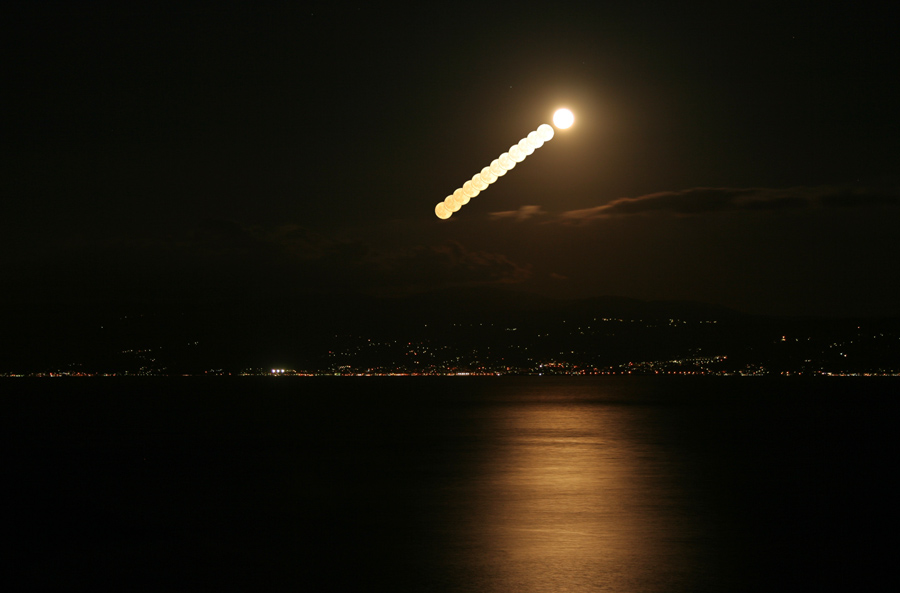
月は地平線に近いとき、大きく見えるのでしょうか?いいえ、上記の図に示すように、月は空上の位置に関係なく、ほぼ同じ大きさに見えます。奇妙なことに、一般的な月の錯覚の原因は未だに議論されています。2つの有力な説明はどちらも、前景の物体によって地平線上の月が遠くにあるように見えるという錯覚に基づいています。歴史的に最も有力な説明は、脳がより遠くの物体を広く解釈するというものですが、より最近の説明では、距離の錯覚によって実際に目の焦点が異なる可能性があると付け加えています。いずれにせよ、月の視直径は常に約0.5度です。上記のタイムラプスシーケンスは2007年に撮影されたもので、1枚の露出でトルコのイズミット湾の前景を映し出しています。創刊14周年を記念して、APOD編集部は、世界中の何百万人もの人々に天文学の素晴らしさを届けるためにボランティアで尽力してくださったすべての寄稿者とミラーサイト運営者に感謝いたします。また、上記のマウスオーバー画像を提供してくださったトルコのミラーサイト運営者の方々にも感謝いたします。
原文(English)
Is the Moon larger when near the horizon? No -- as shown above, the Moon appears to be very nearly the same size no matter its location on the sky. Oddly, the cause or causes for the common Moon Illusion are still being debated. Two leading explanations both hinge on the illusion that foreground objects make a horizon Moon seem farther in the distance. The historically most popular explanation then holds that the mind interprets more distant objects as wider, while a more recent explanation adds that the distance illusion may actually make the eye focus differently. Either way, the angular diameter of the Moon is always about 0.5 degrees. In the above time-lapse sequence of the Moon taken in 2007, with one exposure taken to bring up the foreground of Izmit Bay in Turkey. On the occasion of our 14th anniversary, the APOD editors thank all of our contributors and mirror site operators whose volunteer efforts help bring the wonders of astronomy to millions of people around the world. Additional thanks also go to our Turkish mirror site operators for submitting the above mouseover image.
\ この感動を宇宙仲間にシェア /
宇宙をXでシェア
© Tahir Sisman / APOD