
🚀 宇宙の記憶・カレンダー検索
🚀 象徴的な写真:
APOD第1回
🚀 創造の柱
🚀 スピリット火星着陸
🚀 ハッブル超深宇宙
🚀 地球へようこそ|ブルー・マーブル
🚀 エンケラドス
🚀 ベテルギウス
🚀 火星着陸
🚀 青い夕焼け
🚀 冥王星のハート
🚀 皆既日食
🚀 アースライズ再構築
🚀 ブラックホール
🚀 ウェッブ初画像
🚀 アポロ11着陸
APOD30周年(2025年6月16日)
球状星団オメガ・ケンタウリの中心
The Center of Globular Cluster Omega Centauri
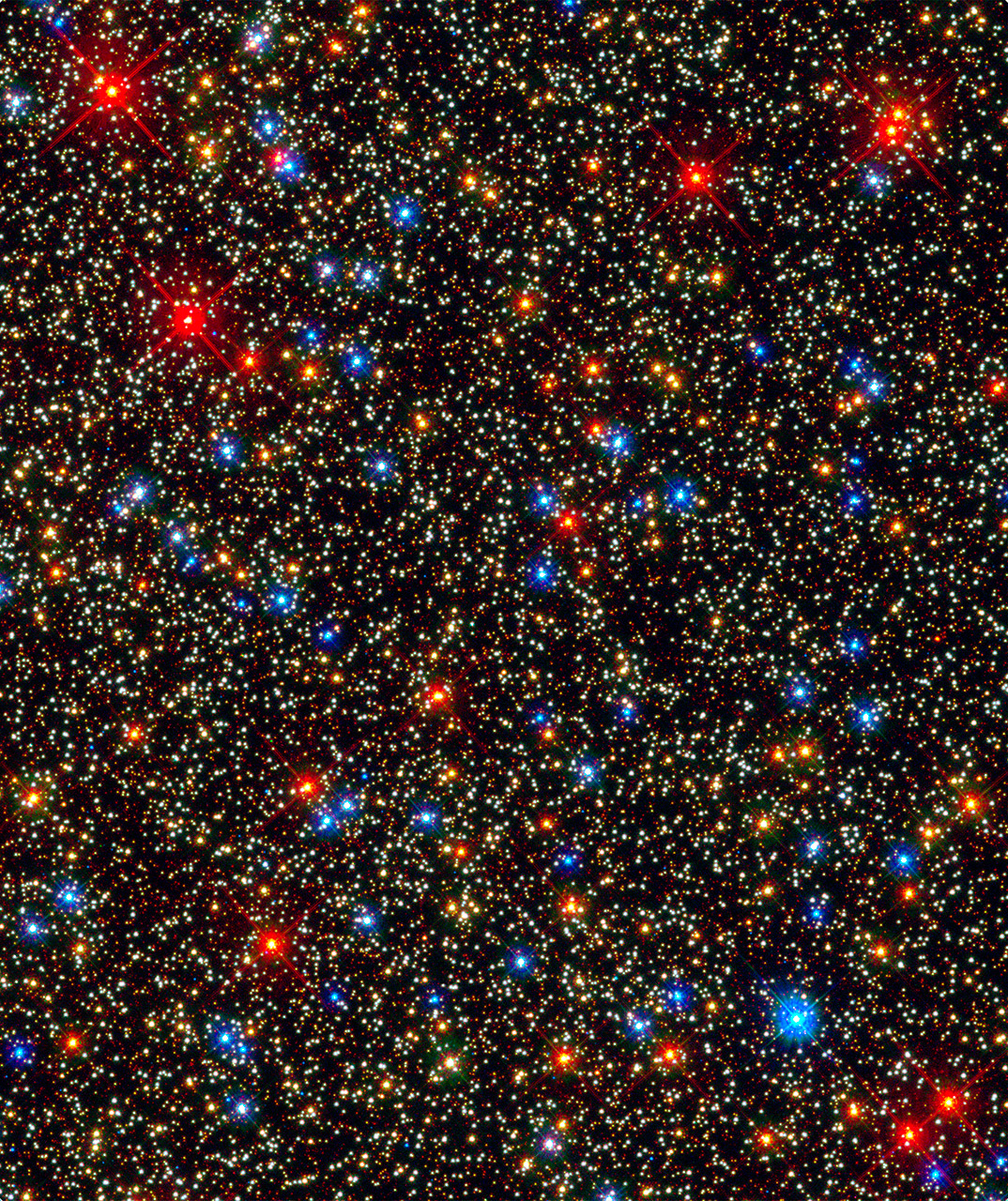
星が衝突した後に残るものは何でしょうか?この疑問に答えるために、天文学者たちは天の川銀河で最も質量が大きい星の球体の中心部を研究してきました。球状星団オメガ・ケンタウリの中心部では、星は太陽付近の1万倍もの密度で密集しています。上の画像は、新しくアップグレードされたハッブル宇宙望遠鏡がオメガ・ケンタウリの中心部を個々の星に分解した様子です。太陽よりも小さい淡い黄白色の星、赤色巨星である黄橙色の星、そして時折見られる青い星が多数写っています。2つの星が衝突すると、おそらく合体してさらに質量の大きい星になるか、あるいはそのままくっついて新しい連星系を形成します。近接連星は相互作用し、一方の星から白色矮星や中性子星のようなコンパクトな伴星の表面にガスが落下する際に、紫外線やX線を放出することがあります。現在、オメガ・ケンタウリの中心部には、このような連星が2つ存在することが確認されています。この星団は約1万5000光年離れた場所にあり、ケンタウルス座の方向に見える。
原文(English)
What is left over after stars collide? To help answer this question, astronomers have been studying the center of the most massive ball of stars in our Milky Way Galaxy. In the center of globular cluster Omega Centauri, stars are packed in 10,000 times more densely than near our Sun. Pictured above, the newly upgraded Hubble Space Telescope has resolved the very center of Omega Centauri into individual stars. Visible are many faint yellow-white stars that are smaller than our Sun, several yellow-orange stars that are Red Giants, and an occasional blue star. When two stars collide they likely either combine to form one more massive star, or they stick, forming a new binary star system. Close binary stars interact, sometimes emitting ultraviolet or X-ray light when gas falls from one star onto the surface of a compact companion such as a white dwarf or neutron star. Two such binaries have now been located in Omega Centauri's center. The star cluster lies about 15,000 light-years away and is visible toward the constellation of Centaurus.
\ この感動を宇宙仲間にシェア /
宇宙をXでシェア
© NASA / APOD