
🚀 宇宙の記憶・カレンダー検索
🚀 象徴的な写真:
APOD第1回
🚀 創造の柱
🚀 スピリット火星着陸
🚀 ハッブル超深宇宙
🚀 地球へようこそ|ブルー・マーブル
🚀 エンケラドス
🚀 ベテルギウス
🚀 火星着陸
🚀 青い夕焼け
🚀 冥王星のハート
🚀 皆既日食
🚀 アースライズ再構築
🚀 ブラックホール
🚀 ウェッブ初画像
🚀 アポロ11着陸
APOD30周年(2025年6月16日)
タランチュラゾーン
The Tarantula Zone
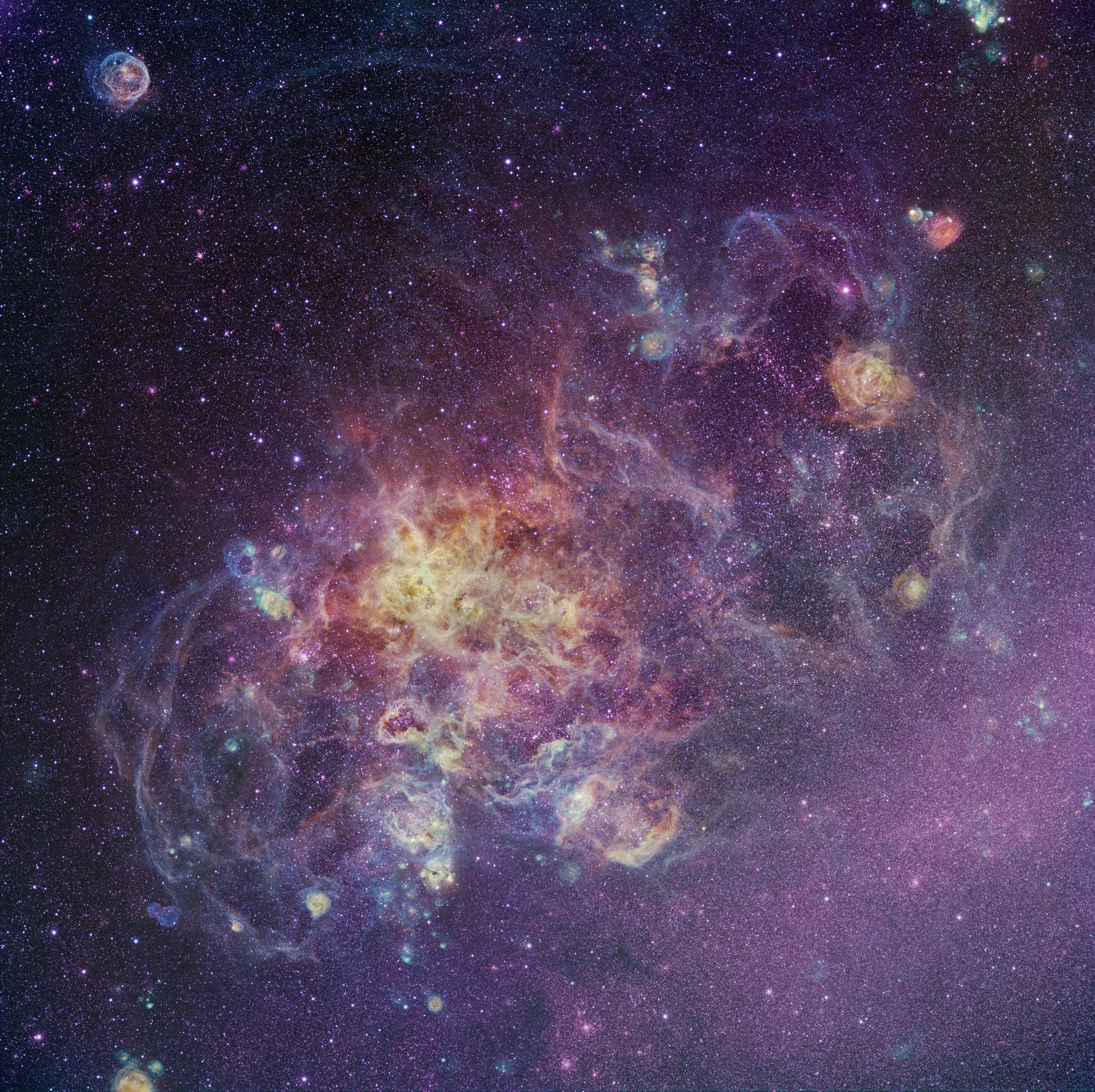
タランチュラ星雲は直径1,000光年以上にも及ぶ巨大な星形成領域で、私たちの隣の銀河である大マゼラン雲(LMC)の中にあります。この宇宙のクモのような星雲は、狭帯域フィルターを通して撮影されたこの鮮明で色彩豊かな望遠鏡画像の中央左側に位置しています。タランチュラ星雲は、LMCの2,000光年以上にわたる部分を覆っています。タランチュラ星雲(NGC 2070)内部では、中心にある大質量星の若い星団(R136としてカタログ化されている)からの強烈な放射線、恒星風、超新星爆発の衝撃波が星雲の輝きを増幅させ、クモの巣状のフィラメントを形成しています。タランチュラ星雲の周囲には、若い星団、フィラメント、泡状の雲など、活発な星形成領域が他にも存在します。この豊かな領域は、南天の星座であるかじき座に位置し、空では満月とほぼ同じ幅です。
原文(English)
The Tarantula Nebula is more than 1,000 light-years in diameter -- a giant star forming region within our neighboring galaxy the Large Magellanic Cloud (LMC). That cosmic arachnid lies left of center in this sharp, colorful telescopic image taken through narrow-band filters. It covers a part of the LMC over 2,000 light-years across. Within the Tarantula (NGC 2070), intense radiation, stellar winds and supernova shocks from the central young cluster of massive stars, cataloged as R136, energize the nebular glow and shape the spidery filaments. Around the Tarantula are other violent star-forming regions with young star clusters, filaments and bubble-shaped clouds. The rich field is about as wide as the full Moon on the sky, located in the southern constellation Dorado.
\ この感動を宇宙仲間にシェア /
宇宙をXでシェア
© John P. Gleason / APOD