
🚀 宇宙の記憶・カレンダー検索
🚀 象徴的な写真:
APOD第1回
🚀 創造の柱
🚀 スピリット火星着陸
🚀 ハッブル超深宇宙
🚀 地球へようこそ|ブルー・マーブル
🚀 エンケラドス
🚀 ベテルギウス
🚀 火星着陸
🚀 青い夕焼け
🚀 冥王星のハート
🚀 皆既日食
🚀 アースライズ再構築
🚀 ブラックホール
🚀 ウェッブ初画像
🚀 アポロ11着陸
APOD30周年(2025年6月16日)
ギャラクシー・ズーが宇宙をカタログ化
Galaxy Zoo Catalogs the Universe
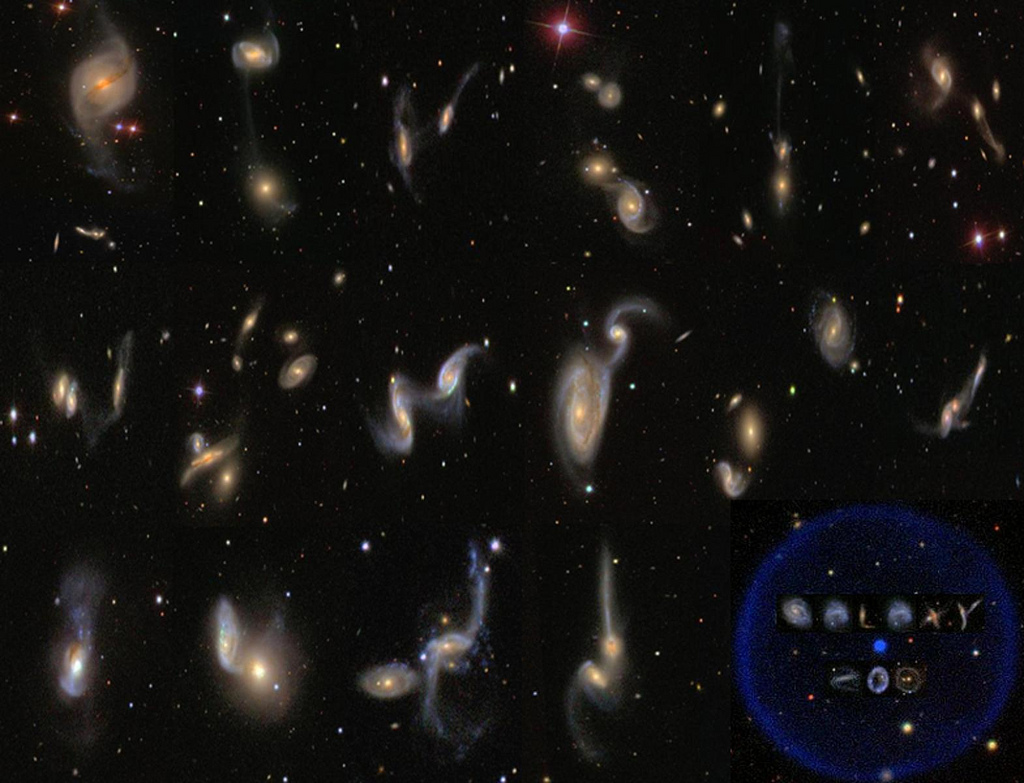
あなたもGalaxy Zooに参加できます。Galaxy Zooプロジェクトは、ウェブブラウザさえあれば、あなたのような好奇心旺盛な市民科学者が宇宙を探索できるようにしてきました。具体的には、簡単なトレーニングセッションの後、ボランティアは自身の優れた画像処理能力を駆使して、広大なスローン・デジタル・スカイサーベイに収録されている銀河の特性を分類・測定するよう求められます。わずか2年の間に、何千人もの熱心なボランティアによって数百万もの銀河が調査されました。Galaxy Zooのデータを用いて、例えば、宇宙には特定の自転方向が存在しないことが発見され、現在も調査中の珍しい未分類の天体が発見され、星形成が非常に活発な「グリーンピース」と呼ばれる小型銀河のグループ全体が発見されました。さらに、Galaxy Zooは、ウェブが人間と機械の知能を収集、集中、調整するのに役立つ、新しいタイプの科学的探究の先例となる可能性を秘めています。上に示したのは、Zooitesによって発見された、鮮やかな銀河の合体群であり、宇宙に存在する多くの相互作用する銀河が、まるで動物園のように多様であることを示している。
原文(English)
You, too, can Zoo. The Galaxy Zoo project has been enabling citizen scientists -- inquisitive people like yourself armed with only a web browser-- to sort through the universe. Specifically, after a brief training session, volunteers are asked to use the superior image-processing power of their minds to classify and measure properties of galaxies in the vast Sloan Digital Sky Survey. In its two short years of existence, millions of galaxies have already been inspected by thousands of enthusiastic volunteers. Using Galaxy Zoo data, for example, the universe has been discovered to create no preferred spin direction, an unusual and unclassified object was found that is still being investigated, and a whole class of small galaxies dubbed Green Peas were uncovered where star formation occurs at an extraordinarily high rate. Further, the Galaxy Zoo may be setting a precedent for a new type of scientific inquiry where the web helps collect, focus and coordinate human and machine intelligence. Pictured above, a group of vibrant mergers found by Zooites demonstrates the diverse zoo-like nature of many interacting galaxies in the universe.
\ この感動を宇宙仲間にシェア /
宇宙をXでシェア
© SDSS,
Galaxy Zoo;
Composite:
Richard Nowell &
Hannah Hutchins / APOD