
🚀 宇宙の記憶・カレンダー検索
🚀 象徴的な写真:
APOD第1回
🚀 創造の柱
🚀 スピリット火星着陸
🚀 ハッブル超深宇宙
🚀 地球へようこそ|ブルー・マーブル
🚀 エンケラドス
🚀 ベテルギウス
🚀 火星着陸
🚀 青い夕焼け
🚀 冥王星のハート
🚀 皆既日食
🚀 アースライズ再構築
🚀 ブラックホール
🚀 ウェッブ初画像
🚀 アポロ11着陸
APOD30周年(2025年6月16日)
クレセント・ネプチューンとトリトン
Crescent Neptune and Triton
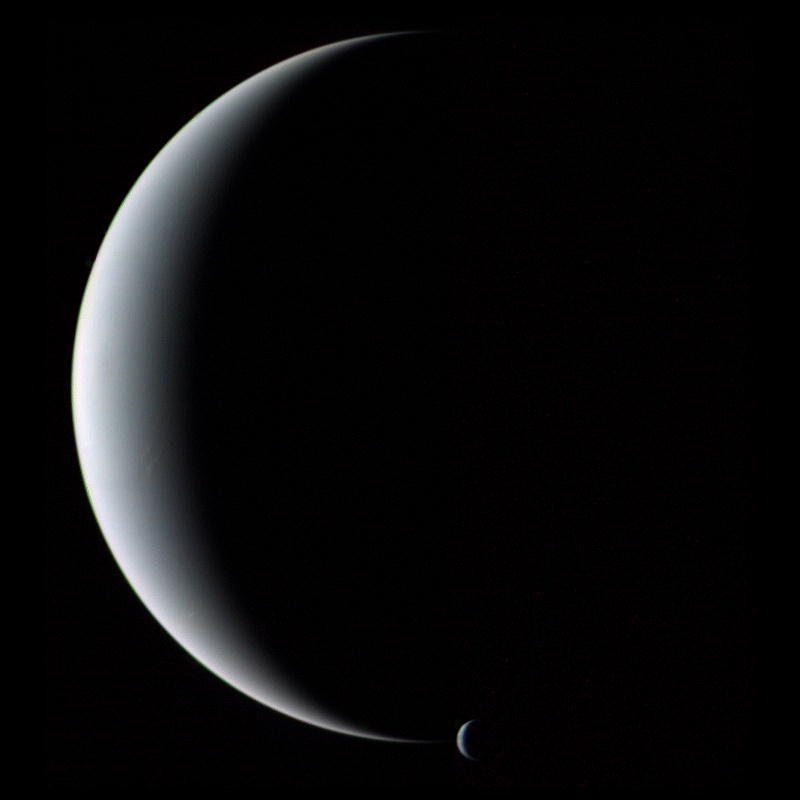
太陽系外縁部を静かに滑空するボイジャー2号探査機のカメラは、1989年に海王星とトリトンが三日月形をしている姿を捉えました。この巨大ガス惑星とその雲に覆われた衛星の写真は、最接近直後に背後から撮影されたものです。海王星は地球から見ると三日月形をしていないため、地球から撮影されたものではありません。この珍しい視点では、海王星は普段見慣れた青色を失っています。ここから見る太陽光は前方に散乱するため、沈む太陽のように赤みを帯びて見えるのです。海王星は天王星よりも小さいですが質量が大きく、複数の暗い環を持ち、太陽から受ける光よりも多くの光を放出しています。新しいミラー:ルーマニアからAPODがルーマニア語で利用可能になりました
原文(English)
Gliding silently through the outer Solar System, the Voyager 2 spacecraft camera captured Neptune and Triton together in crescent phase in 1989. The above picture of the gas giant planet and its cloudy moon was taken from behind just after closest approach. It could not have been taken from Earth because Neptune never shows a crescent phase to sunward Earth. The unusual vantage point also robs Neptune of its familiar blue hue, as sunlight seen from here is scattered forward, and so is reddened like the setting Sun. Neptune is smaller but more massive than Uranus, has several dark rings, and emits more light than it receives from the Sun. New Mirror: APOD now available in Romanian from Romania
\ この感動を宇宙仲間にシェア /
宇宙をXでシェア
© NASA / APOD