
🚀 宇宙の記憶・カレンダー検索
🚀 象徴的な写真:
APOD第1回
🚀 創造の柱
🚀 スピリット火星着陸
🚀 ハッブル超深宇宙
🚀 地球へようこそ|ブルー・マーブル
🚀 エンケラドス
🚀 ベテルギウス
🚀 火星着陸
🚀 青い夕焼け
🚀 冥王星のハート
🚀 皆既日食
🚀 アースライズ再構築
🚀 ブラックホール
🚀 ウェッブ初画像
🚀 アポロ11着陸
APOD30周年(2025年6月16日)
オリオン座で惑星系が形成されつつある
Planetary Systems Now Forming in Orion
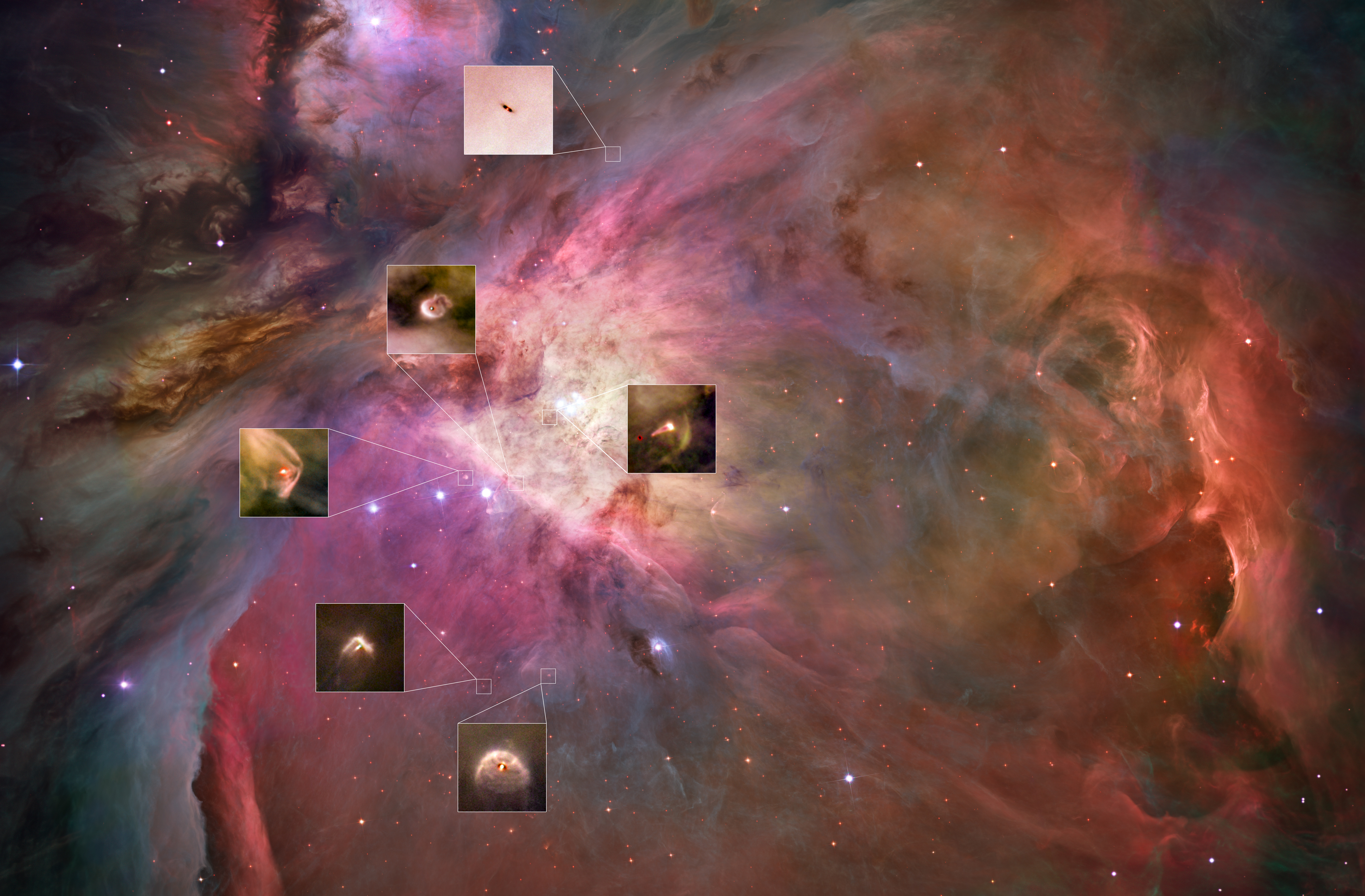
惑星はどのように形成されるのでしょうか?その解明のため、ハッブル宇宙望遠鏡は、天文学的に最も興味深い星雲の一つであるオリオン大星雲を詳細に観測する任務を負いました。オリオン星雲は、オリオン座の三つ星付近に肉眼で見える巨大な星形成領域であり、おそらく天文学的に最も有名な星雲です。上のモザイク画像の挿入図には、多数のプロプリッドが示されており、その多くは惑星系の形成を担っていると考えられる星形成領域です。明るい星の周りの円盤が光り輝くプロプリッドもあれば、主星から遠く離れた円盤を持ち、より低温の塵を含むプロプリッドもあり、そのため明るいガスを背景に暗いシルエットとして見えます。特にこの塵を研究することで、惑星がどのように形成されるかについての洞察が得られます。多くのプロプリッド画像には、衝撃波である弧も写っています。衝撃波とは、高速で移動する物質が低速で移動するガスに遭遇する前線です。オリオン星雲は約1500光年離れた場所にあり、太陽と同じ銀河系の渦状腕に位置しています。
原文(English)
How do planets form? To help find out, the Hubble Space Telescope was tasked to take a detailed look at one of the more interesting of all astronomical nebulae, the Great Nebula in Orion. The Orion nebula, visible with the unaided eye near the belt in the constellation of Orion, is an immense nearby starbirth region and probably the most famous of all astronomical nebulas. Insets to the above mosaic show numerous proplyds, many of which are stellar nurseries likely harboring planetary systems in formation. Some proplyds glow as close disks surrounding bright stars light up, while other proplyds contain disks further from their host star, contain cooler dust, and hence appear as dark silhouettes against brighter gas. Studying this dust, in particular, is giving insight for how planets are forming. Many proplyd images also show arcs that are shock waves - fronts where fast moving material encounters slow moving gas. The Orion Nebula lies about 1,500 light years distant and is located in the same spiral arm of our Galaxy as our Sun.
\ この感動を宇宙仲間にシェア /
宇宙をXでシェア
© NASA / APOD